

The consulting industry is a diverse and dynamic field, but two of its most influential branches are strategy consulting and management consulting. While closely related, they serve different purposes and operate through distinct approaches.
Strategy consulting focuses on high-level, long-term decisions that shape the future direction of a business. Management consulting, in turn, covers a broader range of operational and organizational challenges — from streamlining processes to improving financial performance, HR practices, and technology integration.
Global giants such as McKinsey & Company, Boston Consulting Group (BCG), and Bain & Company have built their reputations by guiding top executives through complex decision-making, leveraging deep market insights and proven frameworks.
In this article, we will explore the key differences between strategy and management consulting, examine the types of problems each addresses, and look at the skills and expertise required to succeed in these fields.
Key differences between strategy consulting and management consulting
Although both strategy and management consulting aim to improve organizational performance, they operate on different levels and address different needs.
1. Strategy Consulting
Focused on the big picture, strategy consulting works with top executives to define an organization’s long-term vision and competitive positioning. Projects typically involve:
- Long-term planning — shaping corporate direction for 3–10 years ahead.
- Market entry and expansion — identifying opportunities in new geographies or sectors.
- Corporate transformation — steering change in times of disruption.
- Innovation strategy — guiding R&D priorities and future product portfolios.
Example: McKinsey has been involved in managing national COVID-19 responses and developing forward-looking strategies such as Hyundai’s electric car charging network. These engagements often involve close collaboration with CEOs, ministers, and other high-profile decision-makers.
2. Management Consulting
Broader in scope, management consulting addresses the how of organizational success — not just the vision, but the systems and processes that support it. This includes:
- Operational improvement — optimizing workflows, supply chains, and resource use.
- Financial restructuring — improving profitability and capital efficiency.
- HR and talent management — enhancing organizational culture and leadership pipelines.
- Technology integration — digital transformations and process automation.
Consulting market overview
The global consulting market continues to evolve, shaped by technological disruption, shifting client demands, and a competitive mix of large firms, boutiques, and niche players. The landscape can be broadly grouped into:
- Global strategy leaders — McKinsey, BCG, Bain: recovering from early 2024 cuts, now pushing AI-driven transformations and success fee models.
- Big four — PwC, Deloitte, KPMG, EY: maintaining project volumes, increasingly focused on implementing initiatives from premium firms.
- Boutique firms — Roland Berger, Kearney, Oliver Wyman: mirroring Big 3 trends, especially in hiring tech-savvy talent.
- Niche specialists — Portas, Alton: thriving in specific domains like sports consulting.
- In-house consulting divisions — Google, Porsche: internal teams with deep company knowledge, sometimes outperforming external consultants in execution.

Tasks and responsibilities of management and strategy consultants
The roles of management and strategy consultants are diverse, combining analytical work, client interaction, and project execution. While the ultimate goal is to improve organizational performance, the specific responsibilities differ depending on the type of consulting.
Core responsibilities of management consultants
Management consultants work across a broad range of business challenges, focusing on the implementation and optimization side of organizational change:
- Problem analysis and diagnosis
-Break down complex business issues into manageable components.
-Conduct in-depth research, analyze data, and identify performance gaps.
-Use benchmarking to compare client performance against industry leaders. - Solution design and strategy development
-Translate client objectives into actionable plans.
-Create operational improvements, process accelerations, or market growth strategies.
-Ensure recommendations are realistic, measurable, and tailored to the client’s resources. - Client engagement
-Work closely with clients to understand needs and gather insights.
-Communicate findings clearly and persuasively.
-Build trust and long-term partnerships through transparency and responsiveness. - Project management and execution support
-Coordinate consulting projects from planning to delivery.
-Maintain timelines, monitor deliverables, and ensure quality standards.
-Support implementation with hands-on guidance, training, and troubleshooting. - Market and industry awareness
-Stay up to date with trends, innovations, and competitor moves.
-Anticipate changes that may impact client industries. - Collaboration across disciplines
-Work with finance, HR, operations, and technology teams to integrate solutions.
-Leverage diverse expertise to improve project outcomes. - Continuous learning
-Develop analytical, communication, and leadership skills.
-Deepen industry knowledge to provide increasingly valuable advice.
Distinctive tasks in strategy consulting
- While management consultants handle a broad operational spectrum, strategy consultants focus more narrowly on high-level decision-making and corporate direction:
- Advising C-suite leaders on long-term growth and competitive positioning.
- Assessing market entry opportunities, M&A, and diversification strategies.
- Identifying disruptive trends and advising on innovation pathways.
- Designing change programs that align with the organization’s mission and vision.
At top firms, even junior consultants can present directly to executives within their first year — a steep learning curve that accelerates both analytical and interpersonal skills.
Are You Ready for a Career a Top Company?
Answer three questions and get a personalized breakdown.
Consulting career paths, opportunities, and hiring trends
A career in management or strategy consulting offers the chance to work on high-impact projects, collaborate with top executives, and develop skills at a pace few other industries can match. Whether you join a global strategy leader like McKinsey, BCG, Bain, a Big Four firm, or a boutique specialist, understanding the career path and the hiring process is essential for breaking into the field.
Pathways into consulting
Most candidates enter through graduate programs, internships, or direct hires after gaining industry experience. To succeed, you need to prepare for two main interview components:
- Personal experience / FIT interview – Sharing well-structured stories that demonstrate leadership, personal impact, entrepreneurial drive, and adaptability (McKinsey introduced “courageous change” as a focus). These are typically delivered using the STAR method and tailored to the firm’s values.
- Case interview – Solving a business problem by structuring your thinking, analyzing data, doing quick math, and generating creative recommendations. McKinsey’s interviewer-led format differs from Bain/BCG’s candidate-led style, which changes how you approach the discussion.
If you want to see a real McKinsey public sector case breakdown, here’s a great example
Preparation usually involves 1–3 months of daily practice, mastering frameworks, solving at least 50–80 cases, and refining your FIT stories. Industry awareness: from banking and FMCG to public sector projects is also crucial, as firms test both sector-specific and general business cases.
Evolving hiring landscape
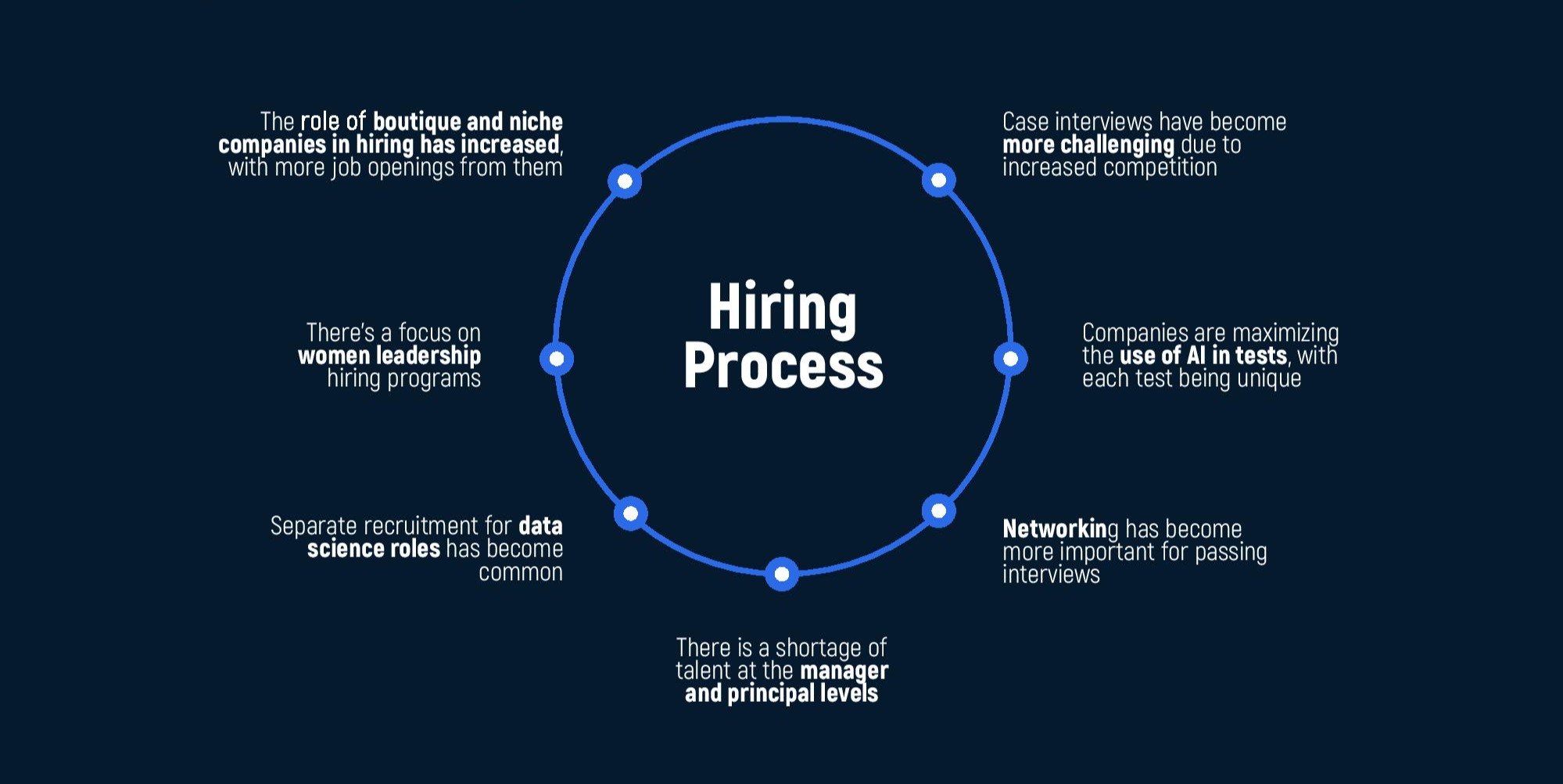
The consulting recruitment process has become more competitive and technology-driven. Key trends in 2025 include:
- Growing opportunities in boutique and niche firms, often with specialized sector focus.
- Increased emphasis on diversity initiatives, such as women leadership hiring programs.
- Separate recruitment tracks for data science and analytics roles. More challenging case interviews due to higher competition.
- Wider use of AI-powered online tests, making each assessment unique.
- Networking gaining importance as a way to stand out among equally qualified candidates.
- Talent shortages at manager and principal levels, opening doors for experienced hires.
Summary and future outlook
The consulting industry is in constant motion, shaped by forces such as digital innovation, AI transformation, and shifting client expectations. These changes are redefining the skills consultants need — from advanced data analysis and tech fluency to adaptability and strategic creativity.
As a career choice, consulting remains highly attractive. It offers rapid professional growth, exposure to diverse industries, and the opportunity to solve complex, high-impact problems alongside talented teams. Consultants develop not only analytical expertise but also a powerful professional network that can last a lifetime.
Looking ahead, the industry’s adaptability will continue to be its strength — enabling it to shape business strategy and influence broader societal progress. The next generation of consultants will need to master both traditional problem-solving and emerging digital skills, while navigating an increasingly competitive hiring process. Those who prepare thoroughly, stay curious, and embrace change will thrive in this dynamic field.
