

Introduction
Pricing is one of the most powerful levers a business can use to shape its financial performance and market position. Unlike cost-cutting initiatives, which usually take months to implement, pricing decisions have an immediate and visible impact on profitability. Even a small adjustment—say, a 5% increase or a redesigned discount model—can drastically improve margins without changing operations.
In the context of consulting and product management interviews, pricing cases are among the most common and insightful exercises. They test a candidate’s ability to combine quantitative reasoning with strategic thinking. You are expected to not only calculate feasible price points but also to consider the bigger picture:
- Who are the competitors and substitutes?
- How do customers perceive value and what is their willingness to pay?
- What are the company’s costs, goals, and strategic priorities?
Strong candidates integrate all these dimensions into a coherent pricing recommendation.
Before diving into frameworks, it is essential to recognize that not all pricing cases are the same. Interviewers often distinguish between two broad categories:
- Commodity pricing cases – focused on basic goods traded on markets or exchanges (such as oil, wheat, copper, or cattle). In these cases, price is shaped primarily by the dynamics of supply and demand.
- Product pricing cases – focused on differentiated goods or services where companies can create and capture additional value through branding, innovation, or superior service (e.g., FMCG, cars, airlines, financial services, electronics).
This article will guide you step by step through both types of pricing cases. We’ll begin with commodity pricing, then move to product pricing and frameworks like the Value Waterfall, switching costs analysis, and profit margin calculations. By the end, you’ll have a clear roadmap for structuring any pricing case in an interview.

Commodity pricing cases
What are commodities?
Commodities are basic goods used in commerce that are interchangeable with other goods of the same type. Because they are standardized and non-differentiated, buyers typically treat one supplier’s output as equivalent to another’s. Commodities are usually traded on organized exchanges and are sorted into four main categories:
- Metals (e.g., copper, gold, aluminum)
- Energy (e.g., crude oil, natural gas, coal)
- Livestock and meat (e.g., cattle, hogs)
- Agricultural products (e.g., wheat, corn, soybeans, coffee)
How are commodity prices determined?
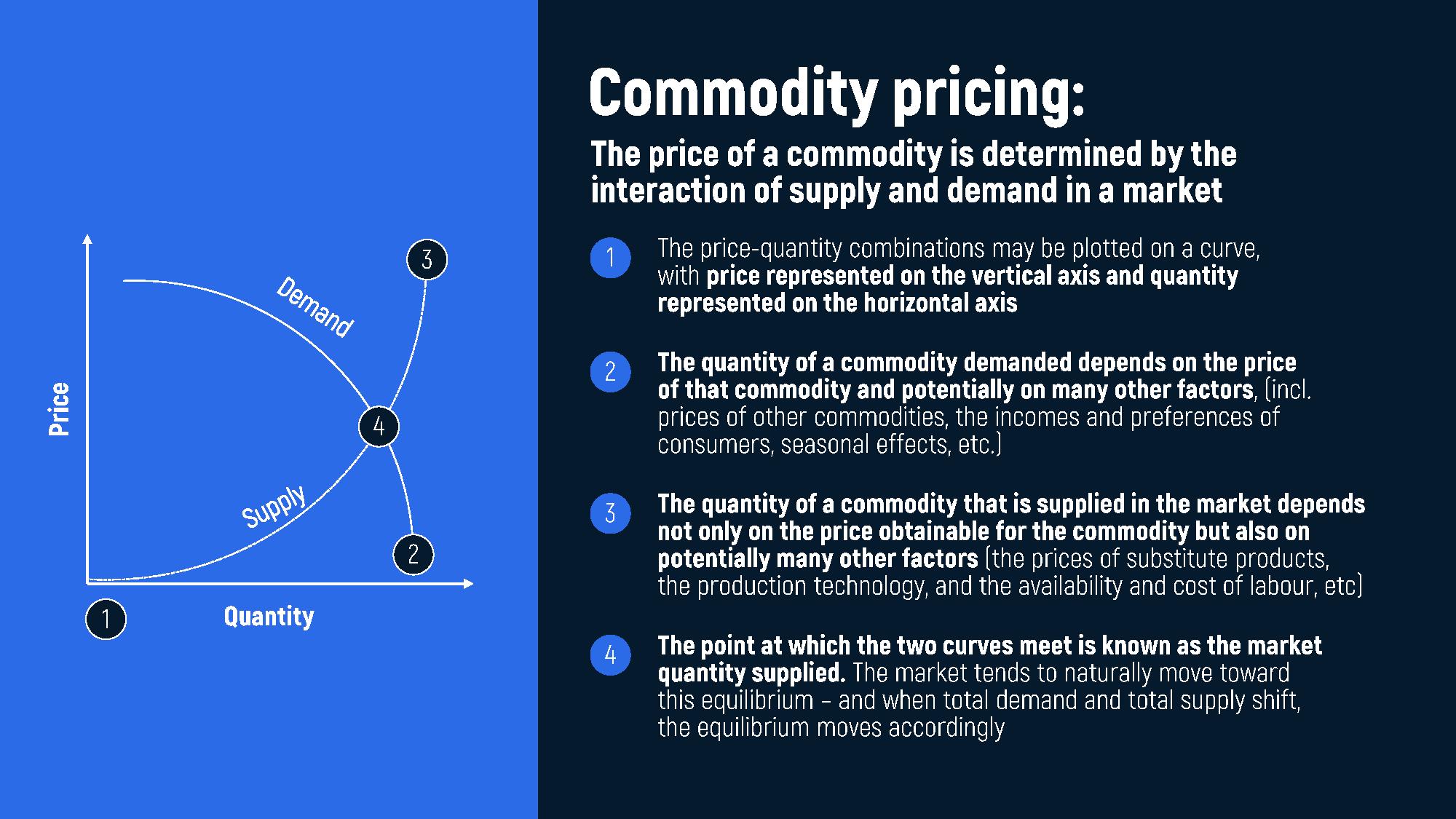
Unlike differentiated products, where branding and customer perception play a role, commodity pricing is fundamentally driven by the interaction of supply and demand in the market.
- Demand factors: The quantity of a commodity demanded depends on its price, but also on related factors such as:
-Prices of substitute commodities (e.g., if natural gas prices rise, demand for coal may increase).
-Consumer incomes and preferences.
-Seasonal effects (e.g., heating oil demand spikes in winter).
-Broader macroeconomic conditions.
- Supply factors: The quantity supplied depends on:
-The price producers can obtain for the commodity.
-Prices of substitute outputs (e.g., farmers switching from wheat to corn).
-Available production technology.
-Labor availability and costs.
-Input costs such as energy or fertilizer.
Market equilibrium
When demand and supply are plotted on a graph, price sits on the vertical axis and quantity on the horizontal axis. The intersection of these curves determines the equilibrium price—the level at which the quantity demanded equals the quantity supplied.
Markets naturally move toward this equilibrium. When total demand or total supply shifts (e.g., due to a poor harvest or a global recession), the equilibrium price also adjusts. For example:
- A drought reducing wheat harvests shifts the supply curve left, pushing up prices.
- A slowdown in construction reduces demand for copper, shifting the demand curve left and lowering prices.
Understanding this mechanism is crucial in commodity pricing cases: your role as a candidate is often to identify the relevant shifts in supply and demand, quantify their impact, and explain how they will influence equilibrium prices.
Product pricing cases
What are product pricing cases?
Unlike commodities, products can be differentiated. Companies add value through branding, innovation, customer experience, and marketing. This makes pricing more complex, because it is no longer just about supply and demand—it’s about how much value customers perceive compared to alternatives.
Typical examples of product pricing cases in interviews include:
- A consumer goods company (FMCG) launching a new premium line.
- An airline deciding how to price a new route.
- A bank structuring fees for a new financial service.
- A tech firm introducing a subscription or usage-based SaaS model.
The three pillars of product pricing decisions
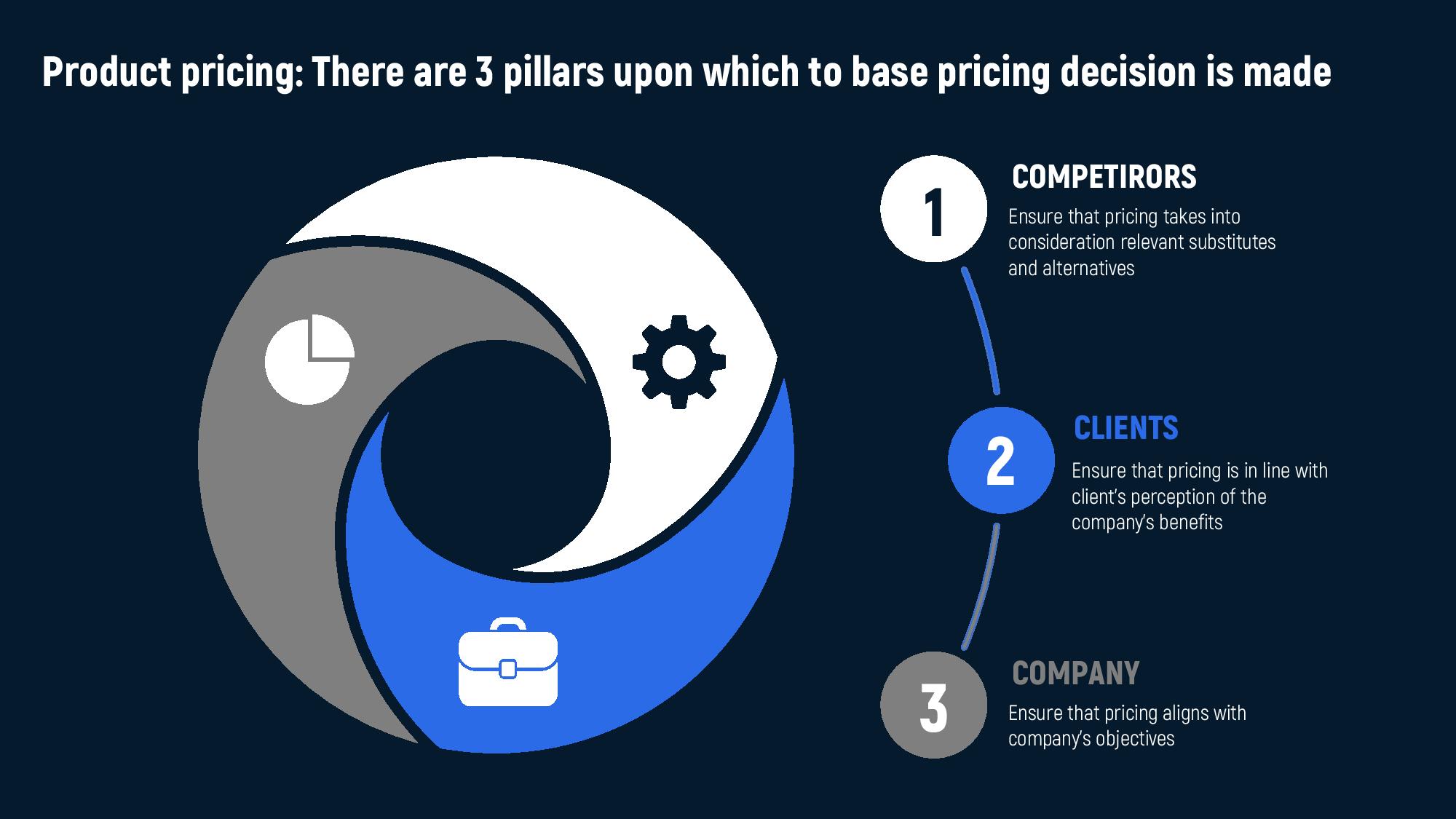
Every product pricing case rests on three interconnected pillars:
1. Competitors
Pricing must account for available substitutes. Customers always compare your offering against alternatives. If your product is significantly more expensive than comparable options without offering clear added value, adoption will suffer.
Example: If a streaming service charges double Netflix’s subscription price but offers no extra features, customers will churn.
2. Clients
Customers ultimately define willingness to pay. Their perception of value may come from convenience, superior features, or brand strength. Importantly, perception is relative: customers might pay more if your product reduces costs, saves time, or improves their experience compared to alternatives.
Example: Businesses often pay more for software that automates manual tasks, because the labor savings outweigh the higher price.
3. Company
Pricing must align with internal strategic goals. A firm may prioritize market share expansion, premium positioning, or profit maximization. At the same time, prices must cover direct costs to remain sustainable.
Example: Apple’s pricing strategy is designed not only to cover costs but also to reinforce its premium brand identity.
Interview tip: When faced with a product pricing case, structure your answer by explicitly walking through these three pillars. Show the interviewer that you are balancing external market forces (competitors and clients) with internal strategy (company goals).
Are You Ready for a Career a Top Company?
Answer three questions and get a personalized breakdown.
The value waterfall approach
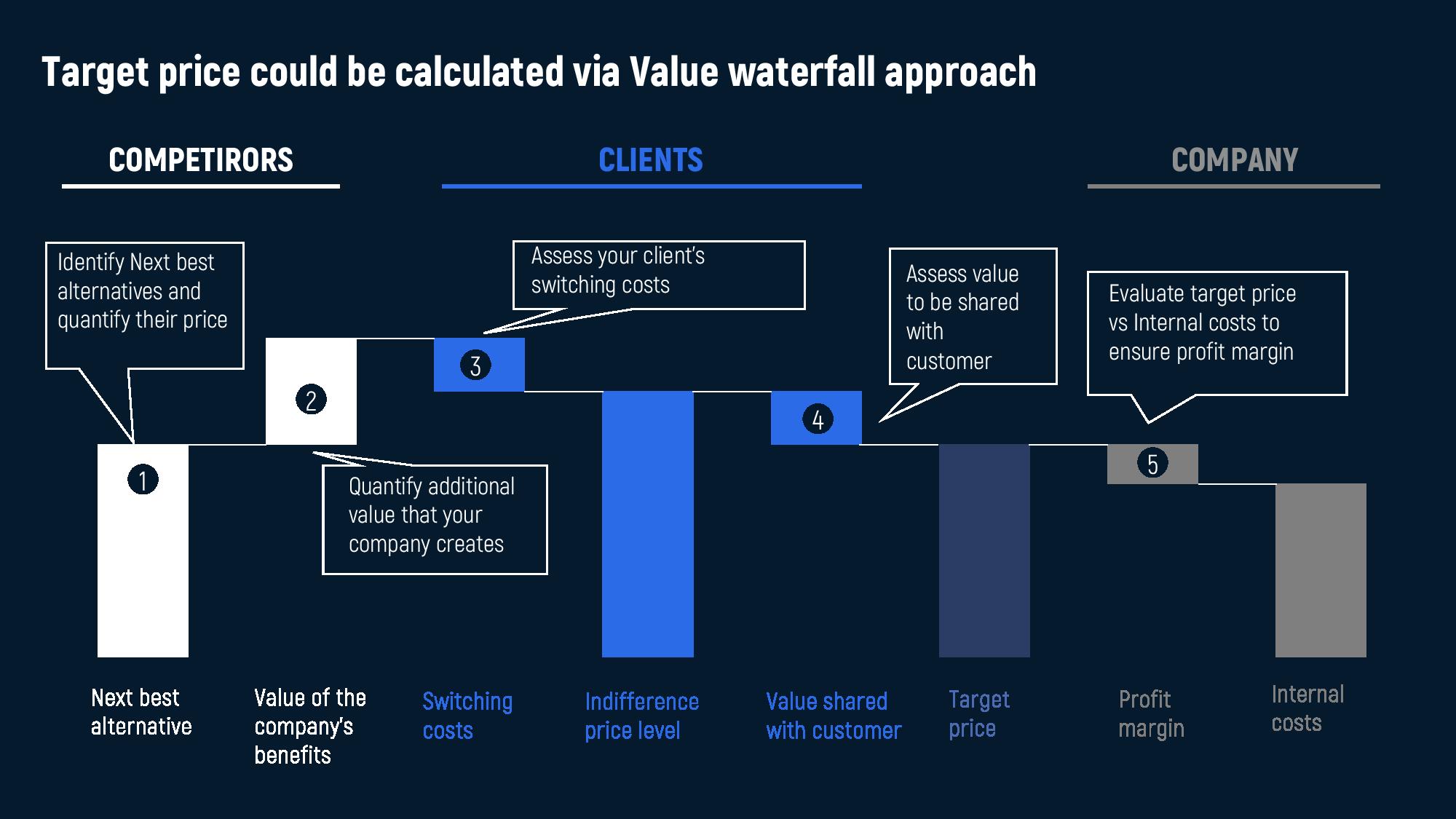
Once the three pillars are clear, the next step is to calculate the target price. One of the most useful frameworks for this is the Value Waterfall, which ensures that every step in the pricing process is logical and grounded.
Step 1: Identify the next-best alternative
Start by identifying competitor offerings. What are customers currently paying for substitutes? This creates a reference point.
Step 2: Quantify the additional value created
Compare your product’s attributes against competitors. How much more efficient, convenient, or desirable is your offering? For instance, if your SaaS product saves 10 hours of work per week compared to competitors, that time-saving has a monetary value.
Step 3: Deduct switching costs
Customers face both financial and non-financial switching costs:
- Financial: forfeited loyalty points, upfront fees, installation costs.
- Non-financial: time and effort required to adapt to a new product (e.g., moving from Windows to macOS).
These costs reduce the customer’s willingness to switch, and therefore must be subtracted when estimating your feasible price point.
Step 4: Define the value to be shared with customers
Not all additional value can be captured by the company. A portion must be shared with customers to incentivize adoption. The strategy depends on competition:
- Price skimming: Start with a high initial price, then reduce over time as demand from early adopters is satisfied and competitors enter.
- Penetration pricing: Launch at a lower price to quickly gain market share and attract price-sensitive customers.
Step 5: Arrive at the target price and check profitability
The final step is to compare your calculated target price against internal costs (labor, materials, logistics, etc.). This ensures that the chosen price yields a sufficient profit margin.
Interview tip: In a case interview, walking through the Value Waterfall step by step shows clear, structured thinking. Even if you don’t have exact numbers, demonstrating the logic earns strong points.
Quantifying competitive advantage
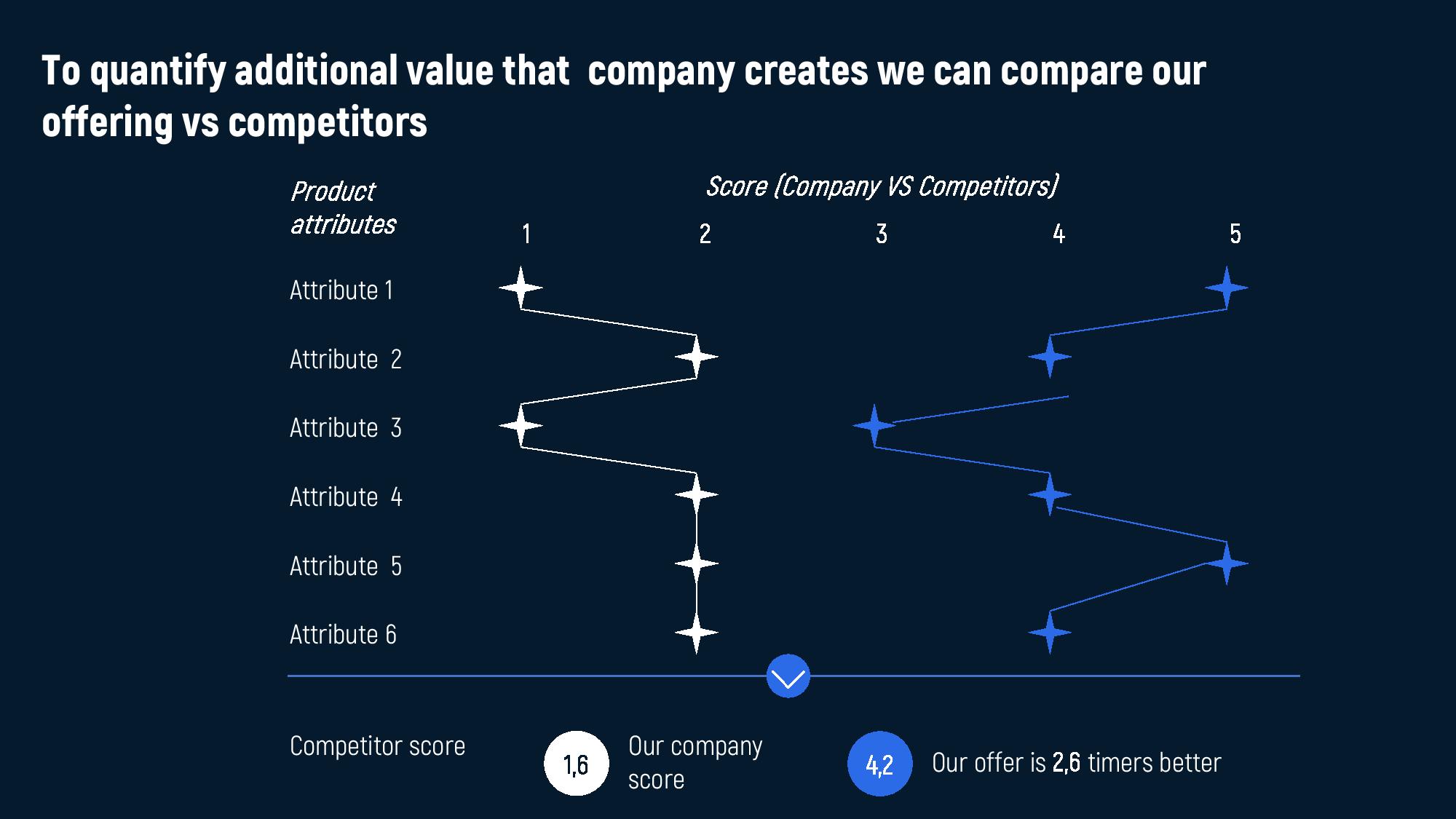
In product pricing cases, it’s not enough to state that your offering is “better” than a competitor’s—you need to measure and demonstrate that difference. A structured way to do this is through attribute comparison scoring.
Step 1: Identify key product attributes
Break down the product into features or qualities that matter to customers. Examples include:
- Speed or performance
- Design and usability
- Integration with other systems
- Customer support
- Brand reputation
Step 2: Assign scores to each attribute
Rate your product and competitor products on a scale (e.g., 1–5). This forces you to make the comparison concrete rather than qualitative.
Step 3: Calculate relative positioning
Add up the scores for your company and for competitors. The ratio reveals how much better (or worse) your product is compared to the alternative.
Example:
- Competitor’s total score = 1.6
- Our company’s total score = 4.2
- Result: Our product is 2.6 times better in terms of customer-perceived attributes.
Why it matters for pricing
If your product scores significantly higher, customers will be less price-sensitive and more willing to pay a premium. Conversely, if your product is only at parity with competitors, pricing power is limited.
Interview tip: Attribute scoring is a great way to show interviewers that you can structure qualitative differences into quantitative insights.
Switching costs
Even when a product is clearly superior, customers may hesitate to switch because of switching costs. These are the costs—financial or non-financial—that consumers incur when moving from one brand, product, or service to another.
1. Financial switching costs
These are direct monetary losses customers face when switching.
- Example: Starbucks app users collect loyalty points for free drinks. If they switch to Costa Coffee, they lose the accumulated Starbucks points. This financial “penalty” discourages switching.
2. Non-financial switching costs
These include time, effort, or inconvenience associated with switching.
- Example: A long-time Windows user switching to macOS must spend significant time adapting to a new operating system. The learning curve acts as a strong non-financial switching cost.
Why switching costs matter for pricing
High switching costs create stickiness—customers are less likely to leave even if your product is slightly more expensive. This gives companies greater pricing power. On the other hand, if switching costs are low, competitors can easily poach customers by undercutting your price.
Interview tip: Always consider switching costs in your analysis. In many cases, they explain why a customer might stick with an inferior or more expensive option.
Value to be shared with customers
After quantifying the additional value your product creates compared to competitors, the next question is: how much of that value should the company keep, and how much should be passed on to customers?
This is where pricing strategies come into play. The choice depends heavily on the competitive landscape and the stage of the product in its lifecycle.
Case 1: No direct competitors
If your product is highly innovative and has no direct substitutes, you can often capture a larger share of the created value. A common strategy in this case is price skimming.
- Price skimming: Charge the highest initial price that early adopters are willing to pay, then gradually lower the price to attract more price-sensitive segments as competition enters.
- Example: Many tech companies (Apple with the iPhone, Sony with new gaming consoles) launch at a premium price to capture maximum margin from enthusiasts before broadening adoption.
Case 2: Market with existing competitors
If similar products already exist, it is risky to set prices too high. A common approach here is penetration pricing.
- Penetration pricing: Launch with a lower price to attract customers quickly, build market share, and encourage switching from competitors.
- Example: Netflix entered international markets with relatively low subscription prices to accelerate adoption before gradually adjusting pricing.
Balancing value capture and value sharing
Ultimately, the company must decide what portion of the incremental value it will capture through price and what portion it will share with customers. Sharing value is often necessary to overcome switching costs, reduce resistance, and drive faster adoption.
Interview tip: In interviews, when asked how to price a new product, explicitly state whether you’d recommend price skimming or penetration pricing, and justify it based on the level of competition.
Ensuring profitability
The final step in pricing is making sure the chosen price not only appeals to customers but also delivers sustainable profit for the company.
Allocating costs
To evaluate profitability, all relevant direct costs must be allocated to the product:
- Direct labor: Salaries, commissions, or contractor costs tied directly to production.
- Direct materials: Raw materials, components, or packaging required for the product.
- Other direct expenses: Distribution, logistics, and transportation costs necessary to deliver the product.
Contribution per unit
The contribution margin per unit = Price – Direct Costs. This is the amount of profit the company makes on each unit sold before accounting for indirect expenses.
If contribution per unit is too low, even high sales volume will not create healthy profits. If it is high, the company has more flexibility to invest in marketing, R&D, or expansion.
Why this matters in interviews
Interviewers want to see that you don’t stop at “finding a price” but also check profitability. The best candidates explicitly test whether the proposed price aligns with both customer value and company costs.
Interview tip: Always close your pricing case by checking the unit economics. State: “At this price, after accounting for labor, materials, and direct expenses, the company earns $X per unit. This margin is sufficient to sustain operations and aligns with the company’s strategic goals.”
Conclusion
Pricing is both an art and a science. The science comes from structured frameworks—understanding supply and demand dynamics in commodities, applying the three pillars of product pricing, using the Value Waterfall to logically calculate target prices, and ensuring profitability by accounting for all costs. The art lies in recognizing customer psychology, assessing switching costs, and choosing the right pricing strategy—whether price skimming to capture early adopters or penetration pricing to quickly build market share.
In consulting and product management interviews, mastering pricing cases is about more than crunching numbers. Strong candidates demonstrate that they can:
- Diagnose whether the case is commodity pricing (driven by market equilibrium) or product pricing (driven by differentiation and customer perception).
- Systematically apply frameworks like the three pillars and the Value Waterfall.
- Balance external market realities with internal company goals.
- Validate that the final recommendation ensures sustainable profitability.
Ultimately, pricing cases are a direct reflection of real-world business challenges. Executives in boardrooms ask the same questions you will face in interviews: How do we position against competitors? How much value do customers really perceive? How much of that value should we capture? And does the price ensure profitability?
By mastering these concepts, you’ll be able to confidently structure and solve pricing cases in interviews—and more importantly, translate that skill into driving growth, profitability, and strategic advantage in real-world business settings.
