

Investment banking is one of the most competitive and fast-paced areas in finance, offering a front-row seat to some of the largest and most complex deals in the business world. From advising on billion-dollar mergers and acquisitions to helping companies raise capital for expansion, investment bankers work at the intersection of strategy, markets, and corporate decision-making.
For candidates considering this path, the appeal is clear: rapid skill development, high earning potential, and the opportunity to work on projects that make headlines. At the same time, it’s a demanding career that requires long hours, attention to detail, and the ability to perform under pressure.
In this article, we’ll break down what investment banking is, the roles and responsibilities you can expect, and the skills needed to succeed — giving you a clear starting point for your journey into the industry.
If you’re still exploring how investment banking compares to other top business careers, check out Comprehensive Guide to Careers in Management Consulting, Product Management, and Investment Banking.
It gives a clear overview of the differences between these fields, typical roles, and long-term growth opportunities.
What is investment banking?
Investment banking is a specialized sector of finance that focuses on helping organizations raise capital, manage financial risks, and achieve strategic growth. It acts as an intermediary between businesses, governments, and investors, facilitating transactions like mergers and acquisitions (M&A), initial public offerings (IPOs), and debt or equity financing.
Investment banks also provide advisory services, offering expert guidance on complex financial decisions and market opportunities. They play a crucial role in structuring deals, pricing securities, and connecting entities to global markets.
The industry is divided into several areas, including corporate finance, trading, asset management, and research, each contributing to the broader goals of supporting economic growth and creating value for clients. Investment banking is dynamic and highly competitive, requiring analytical skills, financial acumen, and adaptability to succeed. This sector allows large-scale economic activity worldwide.
What kind of work can you expect in Investment Banking?
Investment banking is centered around helping clients raise capital, execute mergers and acquisitions, and provide strategic financial advice. While the scope of work varies by bank, team, and industry focus, most roles involve a mix of analysis, client communication, and deal execution. Typical responsibilities include:
- Analyzing businesses – studying financial statements, market trends, and competitive positioning.
- Creating pitch decks – preparing polished presentations for clients and investors to showcase opportunities and recommendations.
- Building valuation models – estimating a company’s worth using financial modeling techniques such as DCF, precedent transactions, and comparable company analysis.
- Supporting deal origination – researching potential targets or investors and preparing materials to initiate conversations.
- Negotiating deal terms – assisting in discussions on structure, pricing, and conditions of transactions (more common in senior roles).
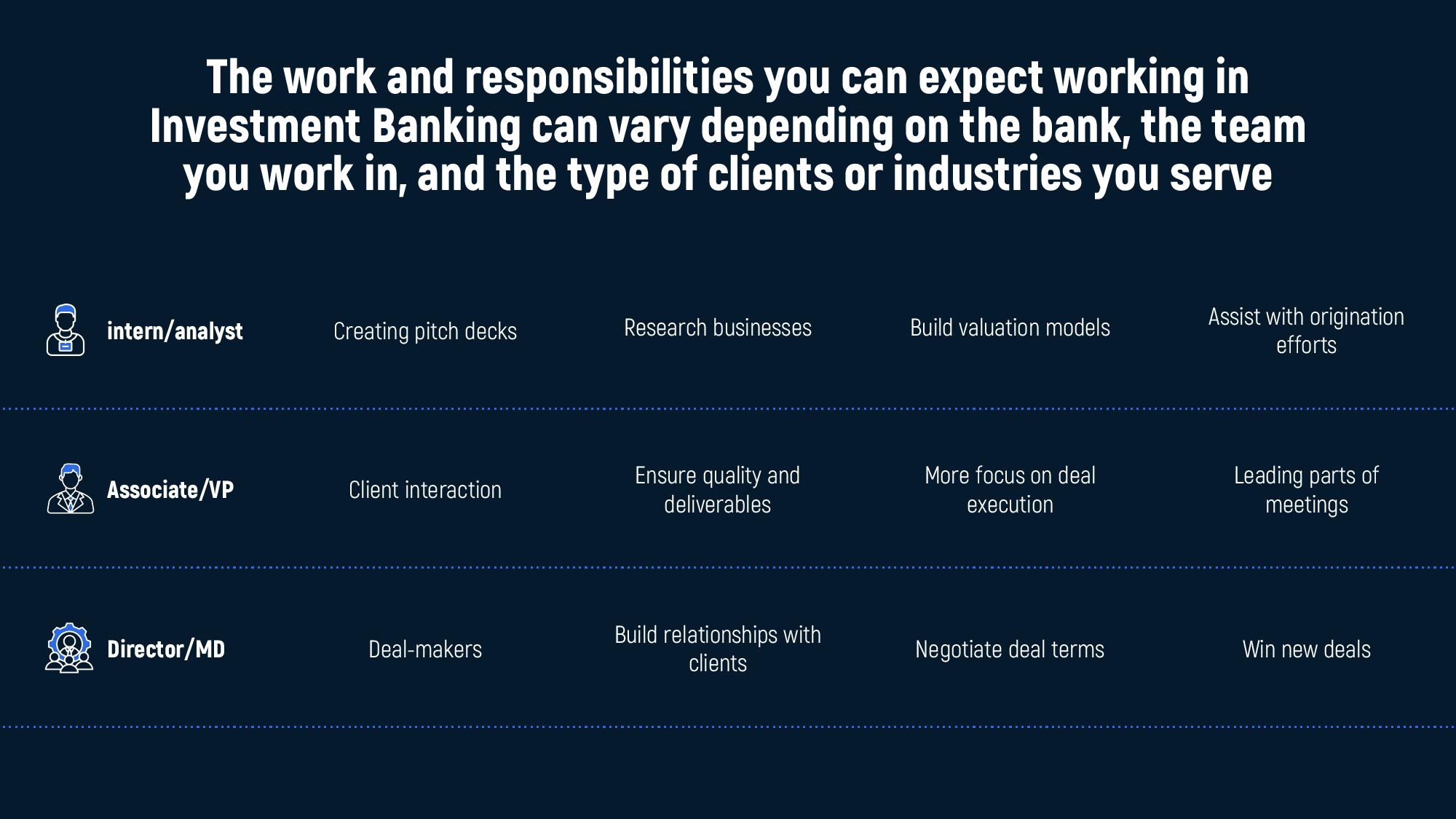
The specific nature of your work depends on your position in the hierarchy. Here’s how it typically breaks down:
- Intern / Analyst – Heavy focus on research, data analysis, financial modeling, and presentation preparation.
- Associate / VP – More client-facing work, ensuring quality of deliverables, and taking ownership of portions of deal execution.
- Director / Managing Director (MD) – Primarily responsible for relationship-building, high-level negotiations, and winning new business.
To understand how these roles fit into the broader progression of the industry, explore the Guide to the Investment Banking Career Path.
It breaks down each position, responsibilities, timelines for promotion, and expected compensation.
What lifestyle can you expect working in investment banking?
Investment banking is known for long hours, especially at the junior levels. As an analyst or associate, it’s common to work up to 70 hours a week, including late nights and weekends, especially when preparing for deadlines or deals. You are expected to manage your time efficiently, as the fast pace often leaves little room for work-life balance.
However, as you move up the ranks, your hours tend to improve. Senior roles, such as VP and director, involve more strategic work and client interaction, often allowing for greater flexibility. While the demands remain high, many find the experience rewarding due to the skills gained, exposure to high-profile deals, competitive compensation, as well as exit opportunities.
If you’re serious about breaking into the field, read How to Get Into Investment Banking — a step-by-step roadmap covering networking, recruiting timelines, resumes, interviews, and technical preparation.
Are You Ready for a Career a Top Company?
Answer three questions and get a personalized breakdown.
Current trends in investment banking
Investment banking is undergoing significant transformation, driven by technological innovation, regulatory changes, and a growing emphasis on sustainability. The most notable trends shaping the industry include:
- Digital Transformation – Affordable data storage, advanced analytics, and new platforms are enabling banks to enhance client experiences, streamline operations, and improve decision-making speed.
- Fintech Integration – Traditional banks are partnering with fintech firms to adopt innovative solutions, expanding service offerings and increasing efficiency.
- Regulatory Changes – Stricter compliance requirements and transparency rules are prompting banks to adapt strategies, adjust operational processes, and strengthen reporting practices.
- Sustainable Finance (ESG) – Environmental, social, and governance criteria are now central to investment decisions, reflecting a shift toward ethical and sustainable investing.
- AI and Automation – Advanced technology is automating routine tasks, improving data interpretation, and delivering actionable insights at unprecedented speed — while keeping human oversight in strategic decision-making.
These trends are redefining how investment banks operate, the skills they require from talent, and the value they deliver to clients.
Key players in the investment banking industry
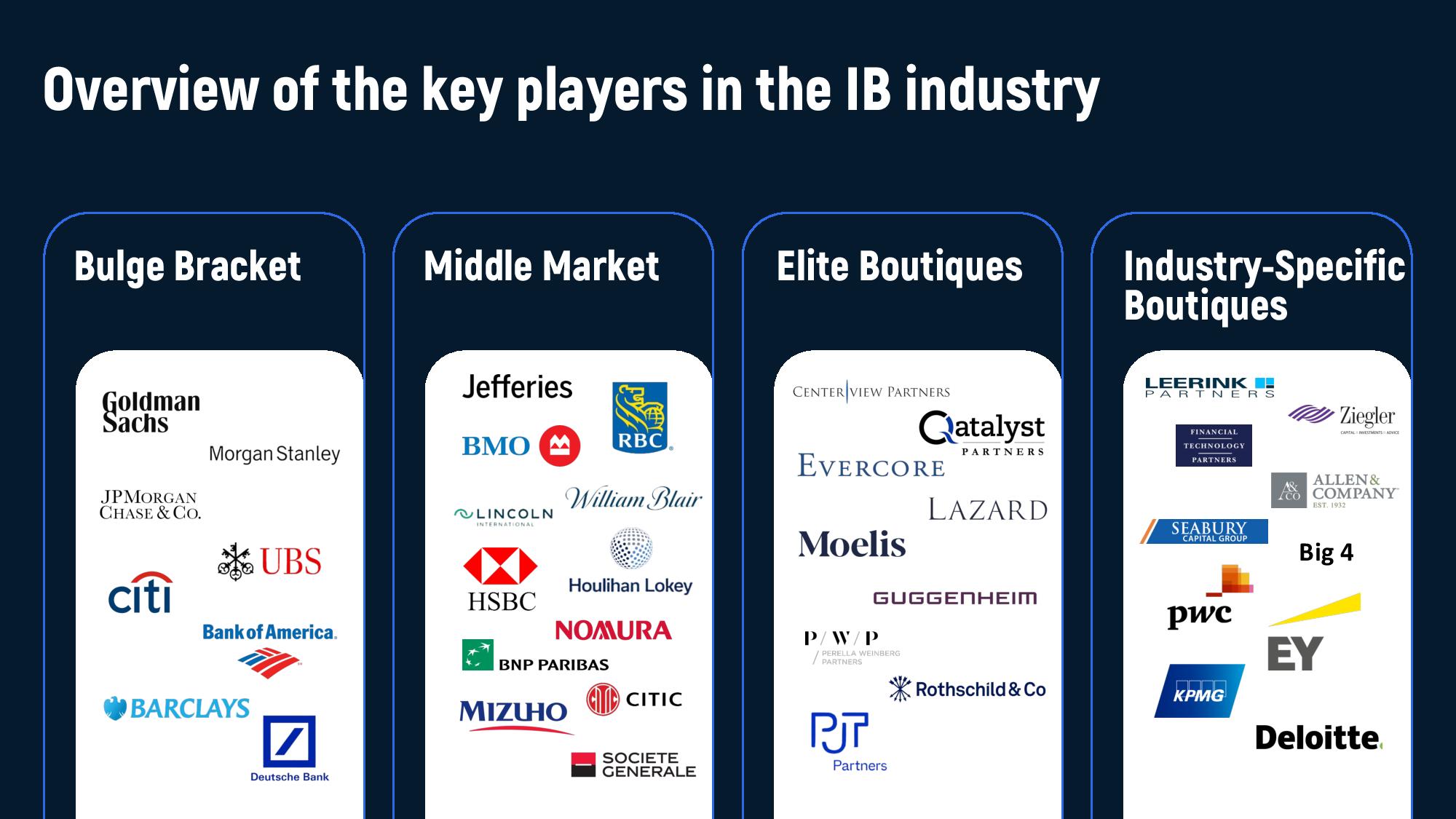
Investment banking is made up of a diverse set of institutions that differ in size, market focus, deal types, and client base. Understanding these categories is essential for candidates deciding where they might fit best.
1. Bulge bracket investment banks
These are the largest and most globally recognized firms, offering a full spectrum of financial services across all major markets. They typically handle the biggest transactions, often valued at over $1 billion, and are known for extensive resources, global reach, and brand prestige.
Examples: JP Morgan, Goldman Sachs, Morgan Stanley, Bank of America, Citigroup, Barclays, UBS, Deutsche Bank.
2. Elite boutique banks
Smaller in size but high in prestige, these firms often specialize in M&A advisory or restructuring rather than a broad range of services. They compete directly with bulge brackets on major deals and offer strong career growth opportunities.
Examples: Lazard, Evercore, Moelis, Rothschild & Co, Centerview Partners.
3. Middle market banks
These mid-sized firms typically handle transactions under $1 billion, serving a broad mix of industries and regions. They provide solid deal exposure and client interaction opportunities, making them appealing for those seeking diverse experience.
Examples: Jefferies, Houlihan Lokey, William Blair, Lincoln International, BMO, RBC.
4. Industry-specific and regional boutiques
Boutiques focus on niche markets or operate within specific geographies. Industry specialists develop deep sector knowledge (e.g., healthcare, fintech, transportation), while regional boutiques serve local markets with tailored expertise.
Examples: Leerink (Healthcare), FT Partners (Fintech), Allen & Co. (TMT), Seabury (Transportation/Maritime/Aerospace), Ziegler (Healthcare, Senior Living, Education).
One of the most common career transitions after investment banking is private equity. If you’re considering that path, don’t miss the Complete Guide on How to Get Into Private Equity.
It explains the recruiting process, skill requirements, interview expectations, and what the day-to-day looks like.
Conclusion and future outlook
The future of investment banking will be shaped by technology, market forces, and global events. AI and automation are streamlining processes, sharpening market insights, and enabling banks to deliver more targeted solutions. Yet, interest rate shifts, inflation, and geopolitical risks remain key challenges requiring adaptability and strategic thinking.
For aspiring professionals, investment banking offers a fast-paced career with opportunities leading to private equity, hedge funds, and corporate leadership. Success will come to those who master technical skills, stay informed on market trends, and embrace change.
In a world of constant transformation, the most successful banks and bankers will be those who see change not as a threat, but as a chance to lead.
Related Reading for Deepening Your Finance & Deal-Making Skills
M&A & Transaction Analysis
- The Ultimate M&A Guide for Aspiring Investment Bankers 2025
A comprehensive walkthrough of the full M&A process — from deal sourcing to valuation, due diligence, and integration. - LBO Explained: What Makes a Company a Strong Buyout Candidate
Understand how private equity evaluates companies, builds LBO models, and structures leveraged transactions.
Financial Accounting, Modeling & Statement Analysis
- Linking the Statements Together: How Accounting Theory Connects Balance Sheet, P&L, and Cash Flow
One of the fundamental skills for IB and equity research — understanding how financial statements flow and reflect real business activity. - Financial Ratios Explained: How to Analyze Business Performance
A clear breakdown of the most important profitability, liquidity, and efficiency ratios used in valuation and credit analysis.
IPO, Markets & Valuation Skills
- IPO Valuation Explained: How Companies Are Priced Before Going Public
A deeper dive into how bankers set the IPO price using comparables, EV calculations, and market sentiment. - EPS, Valuation Multiples, and Market Reactions Guide
Great for understanding how bankers use metrics like EV/EBITDA, P/E, and EPS revisions to shape market expectations.
Career Preparation Beyond Investment Banking
- Consulting Exit Opportunities: Career Paths After Leaving Management Consulting
Many ex-bankers explore strategy consulting, this guide shows how consulting careers evolve and where they can lead. - A Day in the Life of a Product Manager
For candidates curious about alternative high-performance career paths outside finance.
