

Introduction
If you are preparing for a consulting case interview, one of the most important skills you need to master is structuring. A strong structure is what separates top candidates from the rest. It shows the interviewer that you can take an ambiguous business problem, break it down into logical components, and analyze it in a clear, data-driven way.
Many candidates fail not because they lack business knowledge, but because they rely on generic frameworks or present their thoughts in a messy, unstructured manner. They jump straight into calculations without clarifying the problem, or they apply memorized templates that don’t fit the client’s situation. Interviewers immediately notice this — and it often leads to rejection.
In contrast, a well-structured approach demonstrates how consultants think in real projects: hypothesis-driven, logical, and tailored to the industry and client context. It proves that you can work like a consultant from day one, which is exactly what firms like McKinsey, BCG, and Bain are looking for.
In this guide, we will walk through:
- The key structuring principles used in consulting case interviews.
- How to adapt your framework to the problem and industry.
- Practical methods such as splitting, adding, or specifying structure elements.
- How to check your framework for solvability and ensure it is MECE (Mutually Exclusive, Collectively Exhaustive).
- Real-life framework examples for profitability, market entry, and revenue growth cases.
- Pro tips to impress your interviewer with clear and confident communication.
By the end of this article, you will have a step-by-step approach to structuring any consulting case interview, plus practical tips to avoid common mistakes.
Why structure matters in a case interview
A consulting case interview is not just about reaching the “right answer.” In fact, most of the time there isn’t a single correct answer. What interviewers are truly evaluating is how you think. Do you approach the problem in a logical, structured, and hypothesis-driven way — the same way real consultants would approach a client project?
Structure shows clarity of thought
Without a clear structure, your answer can easily become scattered. You might jump between ideas, repeat yourself, or miss critical aspects of the problem. Interviewers describe this as “going in circles.” On the other hand, a strong structure allows you to:
- Break a complex problem into manageable parts.
- Ensure you don’t miss important drivers.
- Communicate your thought process in a way that the interviewer — and eventually a client — can easily follow.
Why interviewers value structure so highly
Consulting firms such as McKinsey, BCG, and Bain want to see that you can think like a consultant from day one. Structuring proves that you can:
- Define the problem clearly.
- Create a logical framework to analyze it.
- Prioritize the most important areas.
- Drive toward actionable recommendations.
This mirrors the daily work of consultants: when faced with a client’s challenge, the very first step is always to structure the problem before diving into analysis.
A messy vs structured example
Imagine you are asked: “Why are this company’s profits declining?”
- Messy answer: “Well, maybe costs are too high, or demand is falling, or maybe competitors are stronger… it could be anything really.”
- Structured answer: “Profitability can be broken down into revenues and costs. Revenues depend on price and volume, while costs split into fixed and variable. Let’s analyze each driver systematically to identify where the decline comes from.”
Both candidates might eventually identify the right cause, but the structured candidate shows consulting-style thinking immediately. That difference is what interviewers reward.
The three key structuring principles for case interviews
When you face a case interview, you cannot rely on random ideas or memorized templates. Your structure needs to be clear, logical, and tailored to the problem. To achieve this, top consulting firms recommend three essential structuring principles: Relevance, Solvability, and MECE.
1. Relevance
Your framework must match the specific problem and industry context. Generic approaches, like simply using the same “profitability framework” in every case, are a red flag.
- Good practice: If the client is a digital bank, your structure should highlight digital channels, loan products, and customer segments.
- Bad practice: Using a standard “banking framework” with only products, customers, and channels, without reflecting the digital nature of the business.
Tip: Always listen carefully to the case prompt and ask clarifying questions. Adapt your buckets so that they address the client’s real situation.
2. Solvability
A strong framework must not only look logical but also be practical to solve. That means you can actually get the data, analyze it, and reach a conclusion.
For example, if your structure includes “brand perception,” but you cannot access data on brand perception within the case, it becomes useless. Instead, focus on factors where data is available: revenues, customer numbers, churn rate, etc.
Checklist for solvability:
- Can I find reliable data?
- Can I analyze it with simple, transparent calculations?
- Will the analysis help me answer the client’s problem?
3. MECE (Mutually Exclusive, Collectively Exhaustive)
The MECE principle is a cornerstone of consulting thinking. It ensures your framework is both clean and complete:
- Mutually Exclusive: Your categories do not overlap. Each item belongs to one bucket only.
- Collectively Exhaustive: Together, your categories cover all possible drivers of the problem.
Example in a profitability case:
- Good MECE: Break revenues into Price × Volume, and costs into Fixed vs Variable. No overlap, and nothing important is missing.
- Not MECE: Break revenues into Price, Volume, and Revenue. Here, “Revenue” overlaps with price and volume, creating confusion.
Why these principles matter
Applying Relevance, Solvability, and MECE helps you:
- Focus on the right drivers of the problem.
- Use data to build a convincing case.
- Show the interviewer that you think like a consultant.
In fact, many candidates lose points not because their math is wrong, but because their structure fails one of these tests. By mastering these principles, you’ll avoid the most common mistakes and build frameworks that truly impress.
Are You Ready for a Career a Top Company?
Answer three questions and get a personalized breakdown.
Tailoring your framework to the case context
One of the most common mistakes in case interviews is applying a generic framework without adapting it to the actual problem. While memorized structures like “profitability” or “market entry” can provide a starting point, interviewers want to see if you can customize your approach to fit the client’s industry, situation, and objectives.
Why generic frameworks are risky
Generic frameworks often sound polished, but they fail to address the nuances of the case. This makes your thinking look superficial and disconnected from the real business problem. For instance, saying “I’ll analyze market, competition, and internal capabilities” works in theory, but it doesn’t show that you’ve understood what really drives the client’s issue.
How to tailor your framework
The key is to adapt your structure based on:
- The case prompt (what is the client’s core problem?).
- The industry context (banking vs retail vs tech).
- Any clarifying answers you receive from the interviewer.
Here are some concrete examples:
Example 1: Revenue Growth Case
- Generic framework: Revenues = Price × Volume.
- Tailored framework (for a subscription-based company): Revenues = Subscribers × ARPU (Average Revenue Per User), with deeper splits into acquisition vs retention and upselling vs cross-selling.
Example 2: Bank Strategy Case
- Generic framework: Products, Customers, Channels.
- Tailored framework (for a digital bank): Focus on mobile app adoption, digital payment systems, online customer acquisition costs, cybersecurity, and partnerships with fintech.
Example 3: Supply Chain Optimization Case
- Generic framework: Suppliers → Manufacturing → Distribution.
- Tailored framework (for a vertically integrated company): Add components such as in-house raw material sourcing, captive logistics, and proprietary technology in distribution.
The interviewer’s perspective
When you tailor your framework, you show the interviewer that you’re not just applying textbook knowledge — you’re thinking like a real consultant. You’ve identified the specific drivers that matter for this client, in this industry, at this moment. That is exactly what consulting firms value.

Three methods to customize your structure
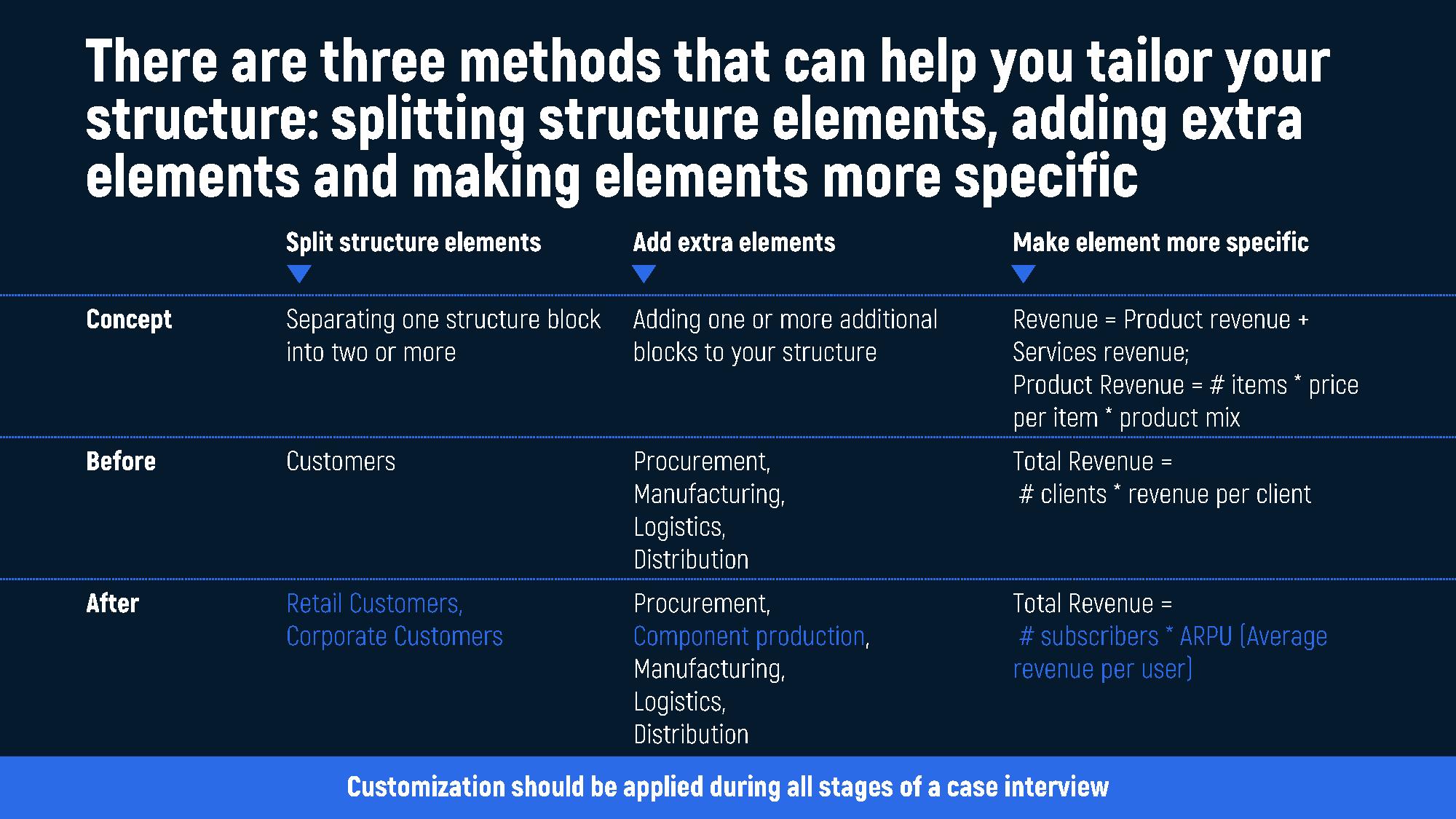
Even the best-known case interview frameworks are only starting points. To truly impress interviewers, you must show that you can adapt and refine them based on the situation. There are three powerful methods for doing this: splitting, adding, and specifying.
1. Splitting elements
Sometimes, a category in your framework is too broad. By splitting it into meaningful subcategories, you make your analysis sharper and more actionable.
- Example: Instead of saying “Customers”, split it into Retail vs Corporate clients, or New vs Existing customers.
- Why it works: It shows you understand that different segments behave differently and may require separate analysis.
2. Adding extra elements
Generic frameworks often miss factors that are crucial in certain industries or situations. Adding an extra element proves you’re tailoring your approach.
- Example: In a supply chain case, the classic structure might include Suppliers → Production → Distribution. But if the company manufactures its own components, you should add “In-house component production” as a separate element.
- Why it works: You capture unique features of the client’s business model, avoiding blind spots.
3. Making elements more specific
Sometimes, a category is too vague to be useful. By making it more specific, you ensure your framework is solvable and more aligned with available data.
- Example: Instead of saying “Revenue per client”, adapt it for a subscription business: “Subscribers × ARPU (Average Revenue Per User)”. This allows you to explore levers like acquisition, churn, and upselling.
- Why it works: Specific elements give you a clearer path to quantitative analysis and actionable insights.
Putting it all together
Imagine you are analyzing why a streaming company’s revenues are stagnating:
- Generic framework: Revenues = Price × Volume.
- Customized framework using the three methods:
-Split: Volume → New subscribers vs Existing subscribers.
-Add: Include Churn rate as a separate factor.
-Specify: Define revenues as Subscribers × ARPU, with ARPU split into Basic vs Premium plans.
Now your structure is relevant, solvable, and far more insightful — exactly what interviewers are looking for.
Checking your framework for solvability
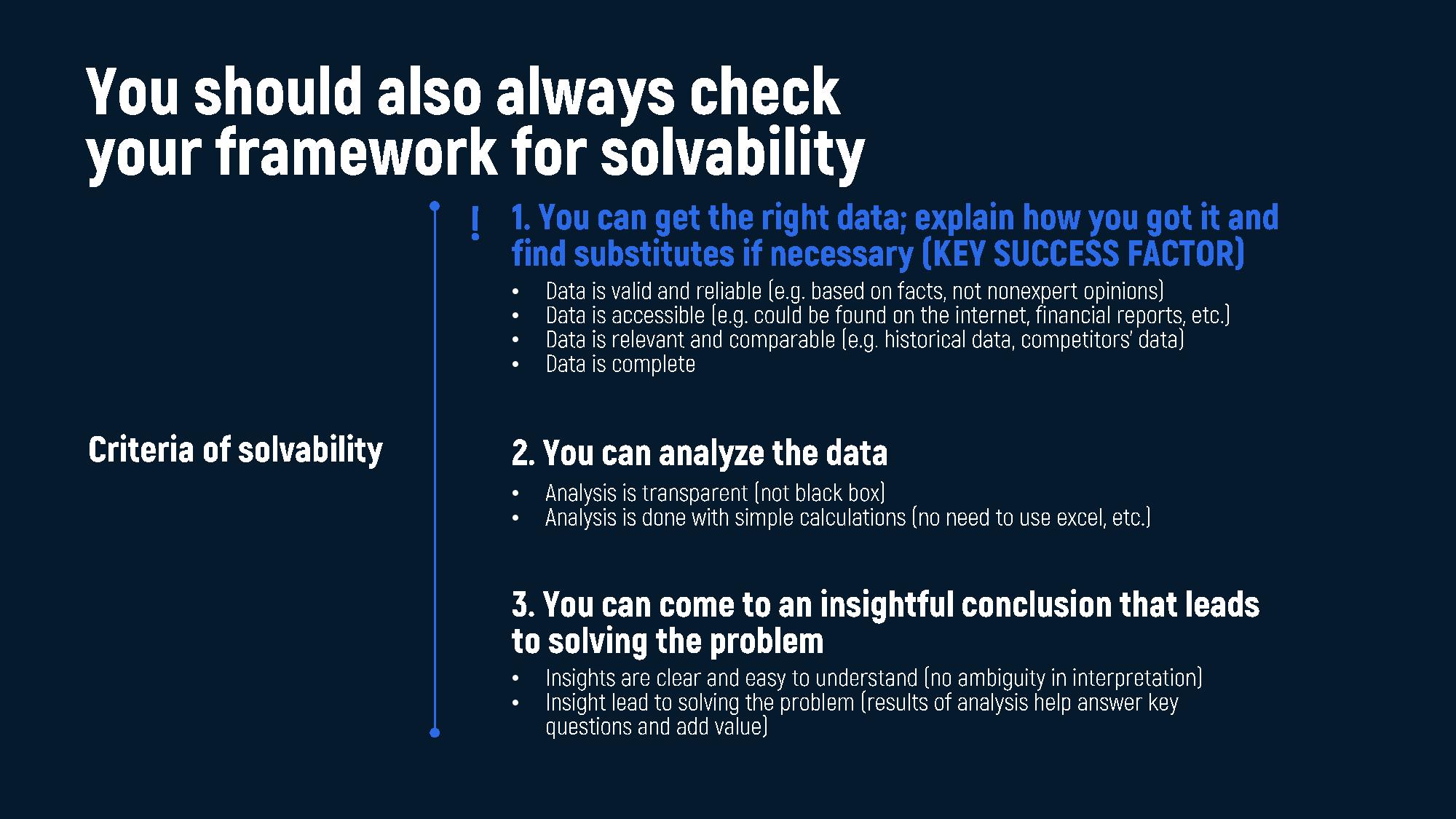
A framework might look elegant on paper, but if it cannot actually be applied in the interview, it becomes useless. That’s why solvability is a crucial test for any case structure. Before presenting your framework to the interviewer, run it through this three-step “solvability filter.”
Step 1: Can you get the right data?
Your structure must be grounded in information you can realistically obtain during the case. Each element should be valid, reliable, accessible, comparable, and complete.
- Good practice: Use buckets like customer volume, pricing, churn rate, or unit costs, since data for these is usually available.
- Bad practice: Suggest factors like brand perception or customer emotions if there’s no way to measure them in the case.
Step 2: Can you analyze it?
Even if data exists, you must be able to analyze it with simple, transparent methods. Case interviews are about clarity, not complex equations.
- Good practice: Use basic ratios and formulas (e.g., Profit = Revenue – Cost).
- Bad practice: Propose overly technical models (like regression analysis or customer lifetime value simulations) that are impossible to run in a 30-minute interview.
Step 3: Can you reach actionable insights?
Finally, your framework should lead you toward business conclusions that solve the client’s problem. If your structure produces only numbers but no insight, it fails the solvability test.
- Good practice: Breaking revenues into Subscribers × ARPU helps you see whether the problem comes from acquisition, retention, or pricing — and what actions could fix it.
- Bad practice: Ending with a vague category like “Market factors”, which doesn’t point to a specific solution.
Mini case example
Imagine you’re asked: “Why is our airline losing profits?”
- Weak structure: Add “Brand image” and “Economic environment” as categories. These are hard to analyze, provide no clear data, and won’t lead to actionable insights.
- Strong structure: Focus on Revenue per passenger (ticket prices × passenger volume) and Cost per flight (fuel, crew, maintenance). This allows you to access clear data, run simple analysis, and identify precise drivers of profit decline.
Deep dive into the MECE principle
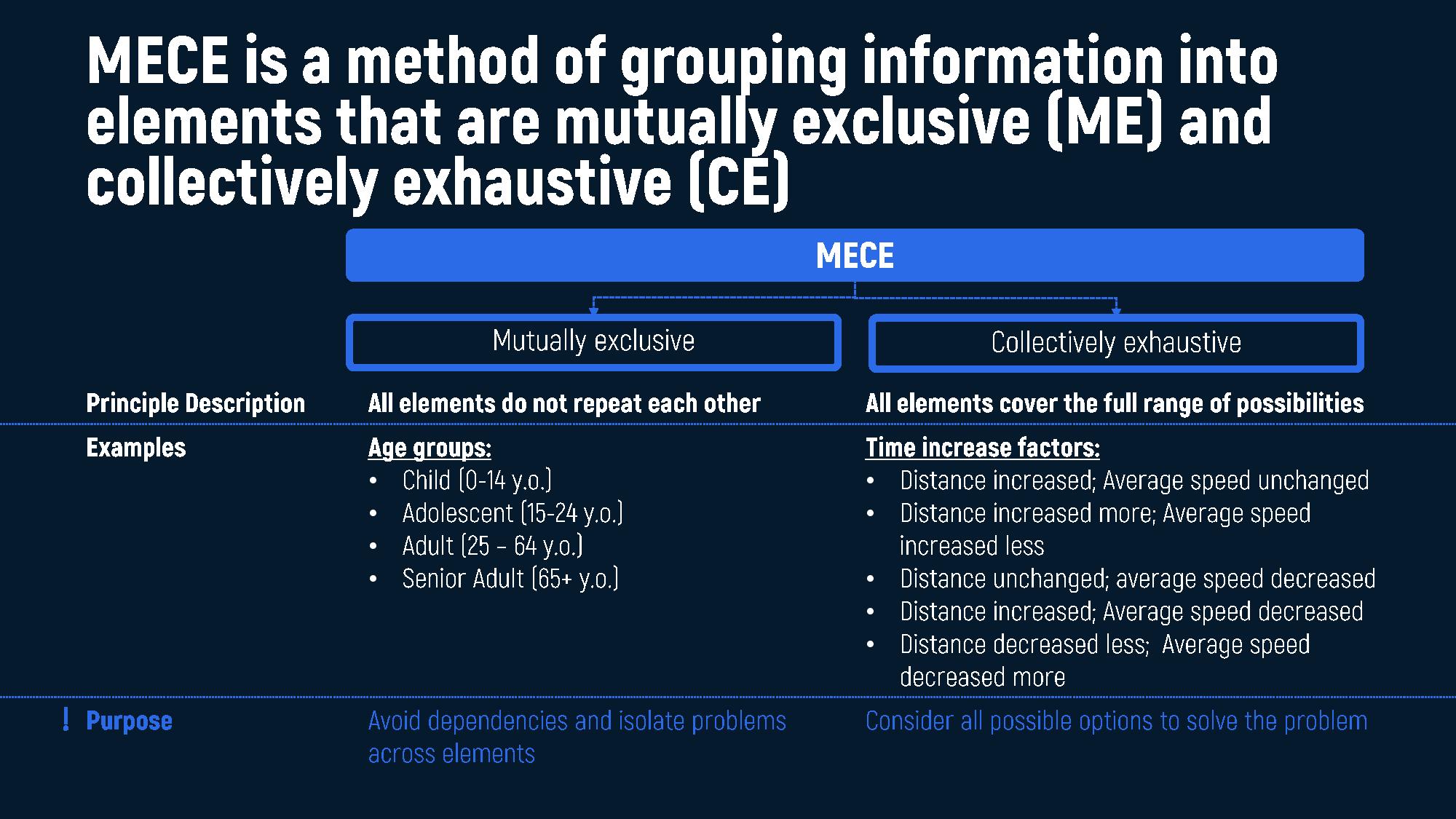
If there is one concept that defines consulting problem-solving, it is the MECE principle: Mutually Exclusive, Collectively Exhaustive. Every candidate aiming for McKinsey, BCG, Bain, or any top-tier consulting firm must understand and apply MECE flawlessly during case interviews.
What does MECE mean?
- Mutually Exclusive (ME): Categories do not overlap. Each driver fits into one — and only one — bucket.
- Collectively Exhaustive (CE): Together, the categories capture all possible drivers of the problem. Nothing important is left out.
When your framework is MECE, your analysis becomes both clear and complete, leaving no room for confusion.
Mutually exclusive: avoiding overlaps
An overlapping structure confuses both you and the interviewer.
- Not ME: Segmenting customers as Children, Teenagers, Adults, and People under 30. Here, the last category overlaps with others.
- ME: Segmenting customers as Children (0–12), Adolescents (13–17), Adults (18–64), Seniors (65+). Each group is unique, no overlap.
Collectively exhaustive: covering all drivers
Leaving gaps in your structure can make you miss the real problem.
- Not CE: An airline profitability structure with only Ticket Price and Fuel Costs. This misses other critical drivers like passenger volume, ancillary revenues, or labor costs.
- CE: A structure with Revenues (Ticket Sales, Ancillary Revenues) and Costs (Fuel, Crew, Maintenance, Overheads). Together, this covers all drivers of profit.
The MECE test in case interviews
Before presenting your framework, quickly test it against MECE:
- Check Exclusivity: Do any categories overlap or duplicate each other?
- Check Exhaustiveness: Does your framework cover every logical driver of the problem?
If the answer to both is yes, your structure passes the MECE test.
In short, MECE is not just a rule — it’s the language of consulting thinking.

Pro tips for structuring case interviews
Even with solid frameworks, many candidates lose points because of weak delivery or poor adaptability. Here are 10 pro tips to help you structure like a top-tier consultant:
- Start with clarifying questions. Never jump straight into structuring. Clarify the objective, definitions, and constraints first.
- State your framework out loud. Walk the interviewer through your logic step by step. Clarity of communication is as important as the content.
- Use a hypothesis-driven approach. Don’t just list buckets. Propose a working hypothesis (e.g., “I believe falling volumes are the main issue”) and test it.
- Check for MECE. Quickly test whether your structure is non-overlapping and complete.
- Keep it solvable. Avoid categories where you can’t get data or draw actionable insights.
- Prioritize. Not all buckets are equally important. Signal which areas you’d explore first and why.
- Adapt on the fly. If new data suggests your framework is missing something, update it confidently. Consultants refine their structures in real projects too.
- Keep it simple. Don’t overcomplicate with jargon or unnecessary subdivisions. Simple and logical beats fancy but confusing.
- Practice verbal delivery. A clear, confident explanation is critical — your interviewer should follow your structure effortlessly.
- Practice with real cases. The best way to master structuring is repetition under time pressure. Use mock interviews to simulate the real experience.
Following these tips ensures you’re not just creating good frameworks, but also communicating them like a consultant.
Conclusion
Structuring is the foundation of every successful consulting case interview. It shows interviewers that you can think like a consultant: breaking down complex problems, focusing on what matters, and guiding your analysis toward actionable recommendations.
To recap, the key structuring principles are:
- Relevance — tailor your framework to the client and industry.
- Solvability — make sure your buckets can actually be analyzed with available data.
- MECE — keep your structure both clean and complete.
By applying these principles, adapting frameworks through splitting, adding, and specifying, and practicing with real case examples, you’ll stand out as a candidate who is not just prepared — but consultant-ready.
Remember: a great structure doesn’t just impress interviewers; it makes your analysis easier, your answers clearer, and your conclusions sharper. In other words, structure is your secret weapon for case interview success.
