

Introduction to formula-based cases
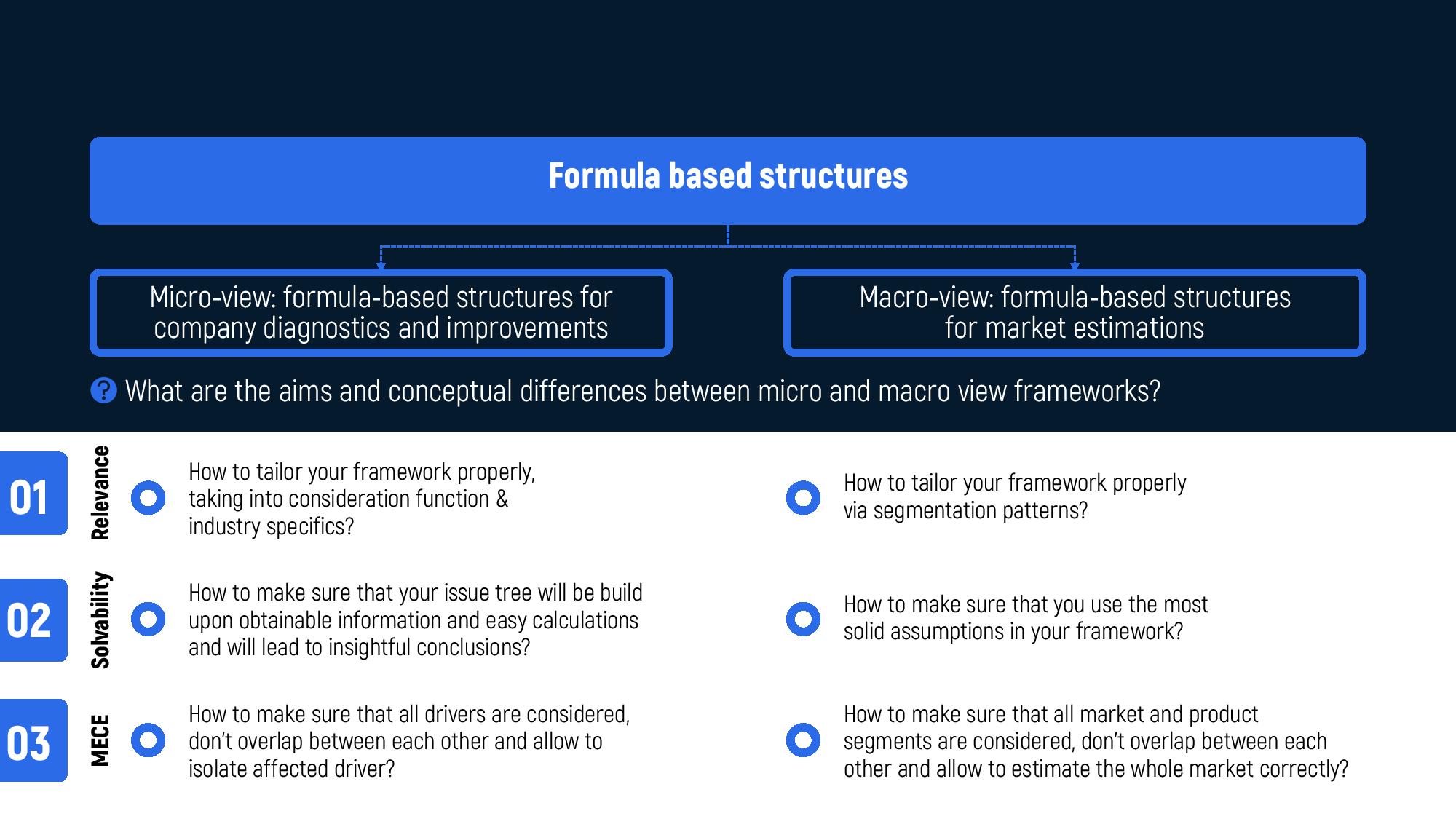
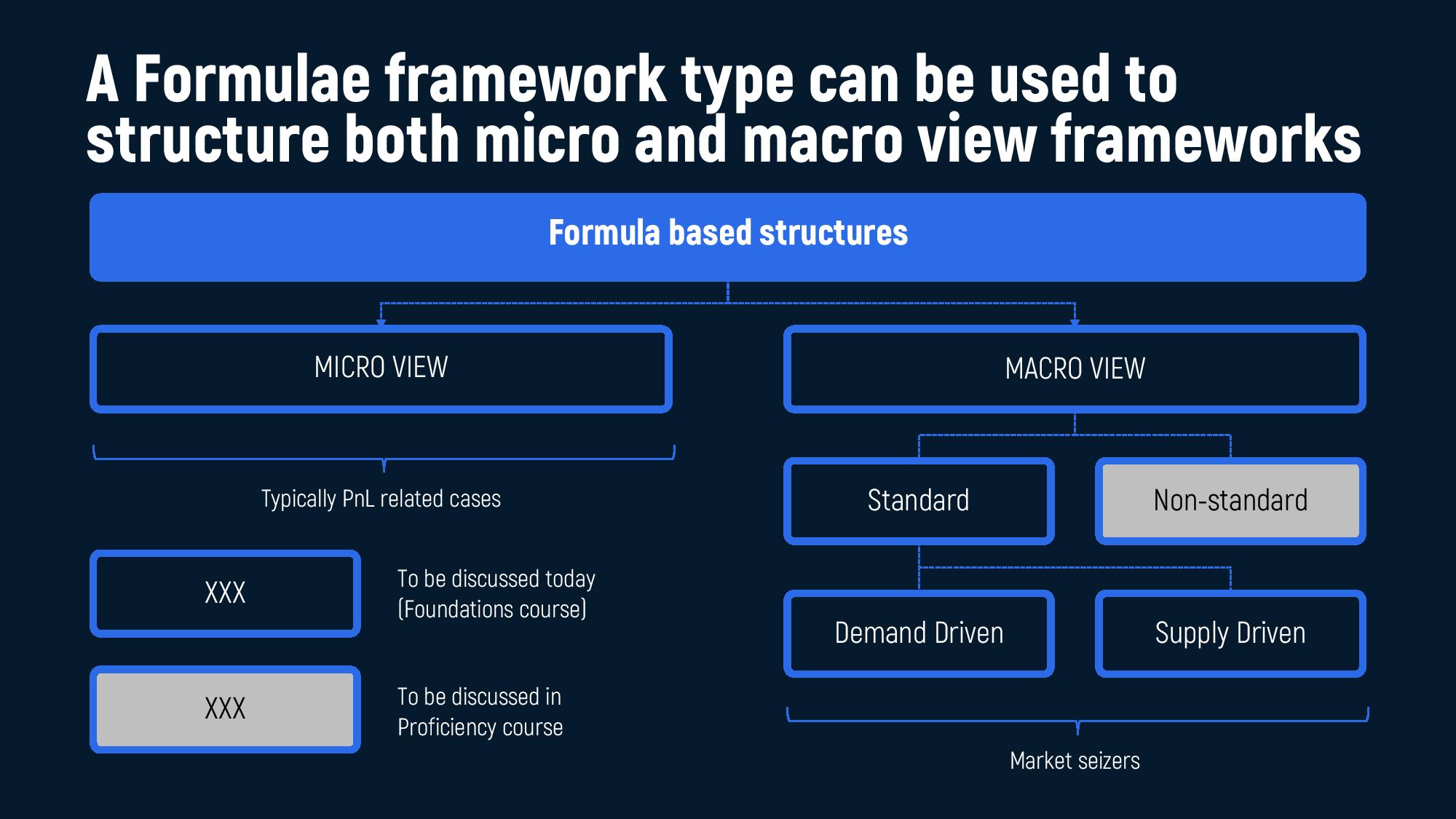
Formula-based cases are one of the most common structures in consulting interviews. They allow candidates to break down complex problems into manageable parts using clear mathematical logic. At the highest level, these cases fall into two categories: micro view and macro view.
- Micro view focuses on profit-and-loss (PnL) related problems, such as breaking down revenues and costs into drivers.
- Macro view covers market sizing cases, which can be demand-driven or supply-driven.
Understanding this split is crucial for interviews, since it determines which formula you’ll apply and how you’ll structure your assumptions.
Micro cases: PnL-driven structures
Micro cases are focused on analyzing profitability. In interviews, they usually come in the form of questions like “Why are profits down?” or “How would you assess if a company should invest in a new product line?”.
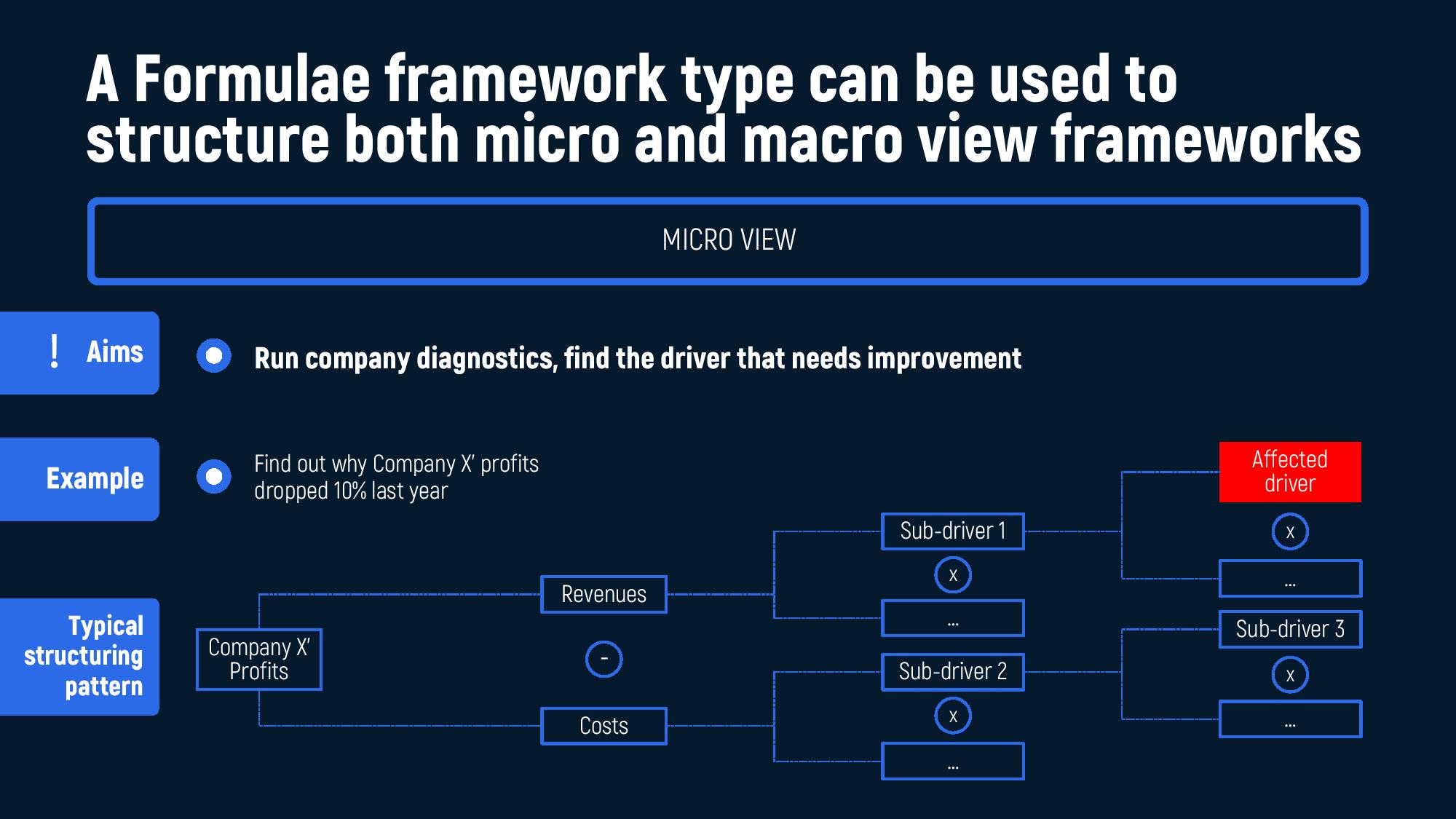
At their core, micro cases are about working with the Profit & Loss (P&L) statement:
Profit = Revenue – Costs
This simple formula can be expanded into detailed drivers:
- Revenue = Price × Volume
You can further break this down into:
-Price: base price, discounts, product mix.
-Volume: number of customers × purchase frequency × average basket size.
- Costs = Fixed + Variable
-Fixed costs: rent, overhead, salaries of permanent staff.
-Variable costs: raw materials, logistics, sales commissions.
By decomposing revenues and costs, you can identify which driver is causing the issue. For instance:
- Falling revenues may come from lower volumes (loss of customers, market share) or declining prices (discount wars, commoditization).
- Rising costs may result from higher raw material prices, supply chain inefficiencies, or bloated overhead.
Macro cases: demand and supply market sizing
Macro cases are some of the most classic and high-frequency questions in consulting interviews. They are designed to test whether you can size a market logically using formulas, assumptions, and structured thinking — not whether you know the exact market size from memory.
At a high level, macro cases are divided into demand-driven and supply-driven market sizings. Mastering both approaches is essential, since interviewers often pick one or the other depending on the industry context.
Demand-driven cases
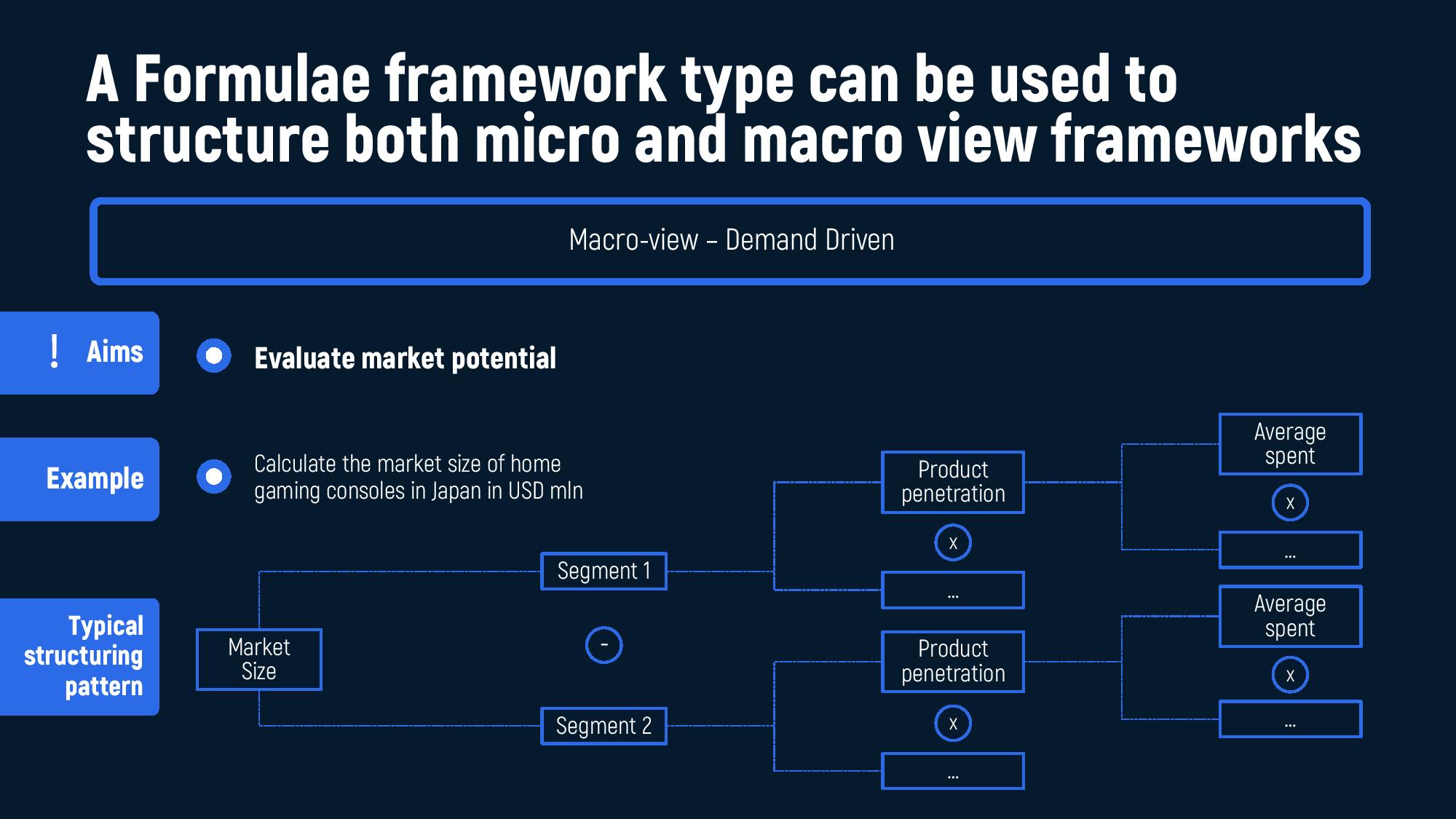
In demand-driven sizing, you start with the customer side and estimate how much total demand exists in the market.
Example question: “Estimate the market size of gaming consoles in Japan.”
A typical formula would look like this:
Market Size = Population × Target Segment Share × Penetration Rate × Average Spending
Breaking it down step by step:
- Population segmentation – Divide the total population into relevant customer groups (e.g., age, income, urban vs. rural).
- Target market share – Choose which segment is realistically relevant for the product (e.g., not everyone in Japan plays games).
- Penetration rate – Estimate what % of this group owns or buys the product.
- Average spending – Multiply by the average purchase value or annual spending.
This logic gives you a structured way to build the answer, even if your assumptions are rough.
Interview tip: The exact number doesn’t matter — what matters is how you explain your assumptions. Interviewers reward clarity and realism in your logic.
Supply-driven cases
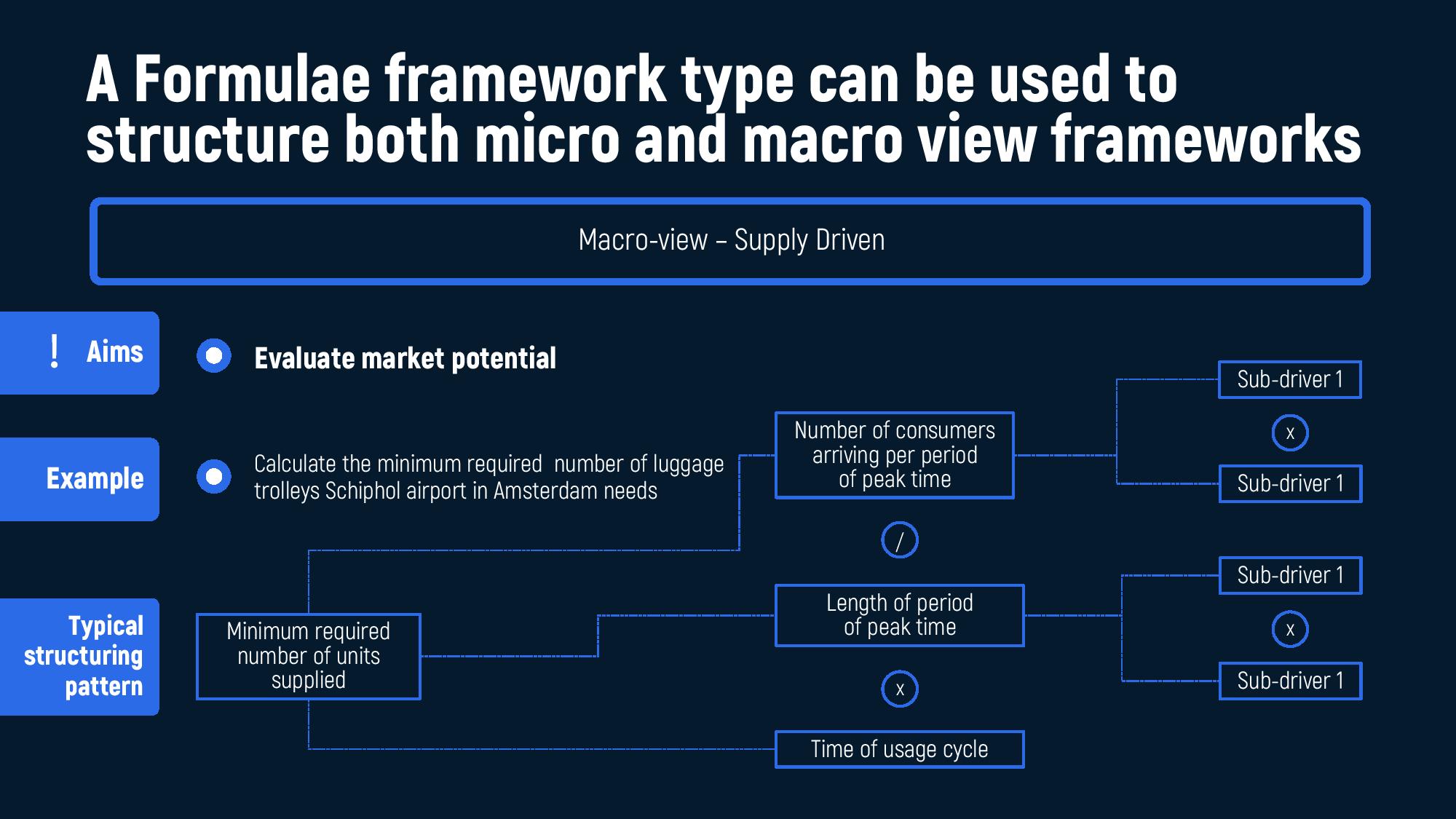
Supply-driven sizing flips the logic: instead of asking “how many customers buy?”, you ask “how many units of supply are needed to serve demand?”
Example question: “Estimate the number of Starbucks stores in London.”
A structured formula could be:
Number of Stores = (Total Coffee Drinkers × Market Share of Starbucks) ÷ Store Capacity
Where:
- Total coffee drinkers = City population × % who drink coffee.
- Market share of Starbucks = % of coffee drinkers who choose Starbucks.
- Store capacity = Operating hours × Customers served per hour.
This approach is particularly common for retail, restaurants, and services, where capacity constraints define how much supply is needed.
💡 Interview tip: Be ready to flex assumptions — e.g., average number of cups per person, store size differences, or urban vs. suburban density. Showing flexibility under pressure is a big plus.
General and industry-specific drivers
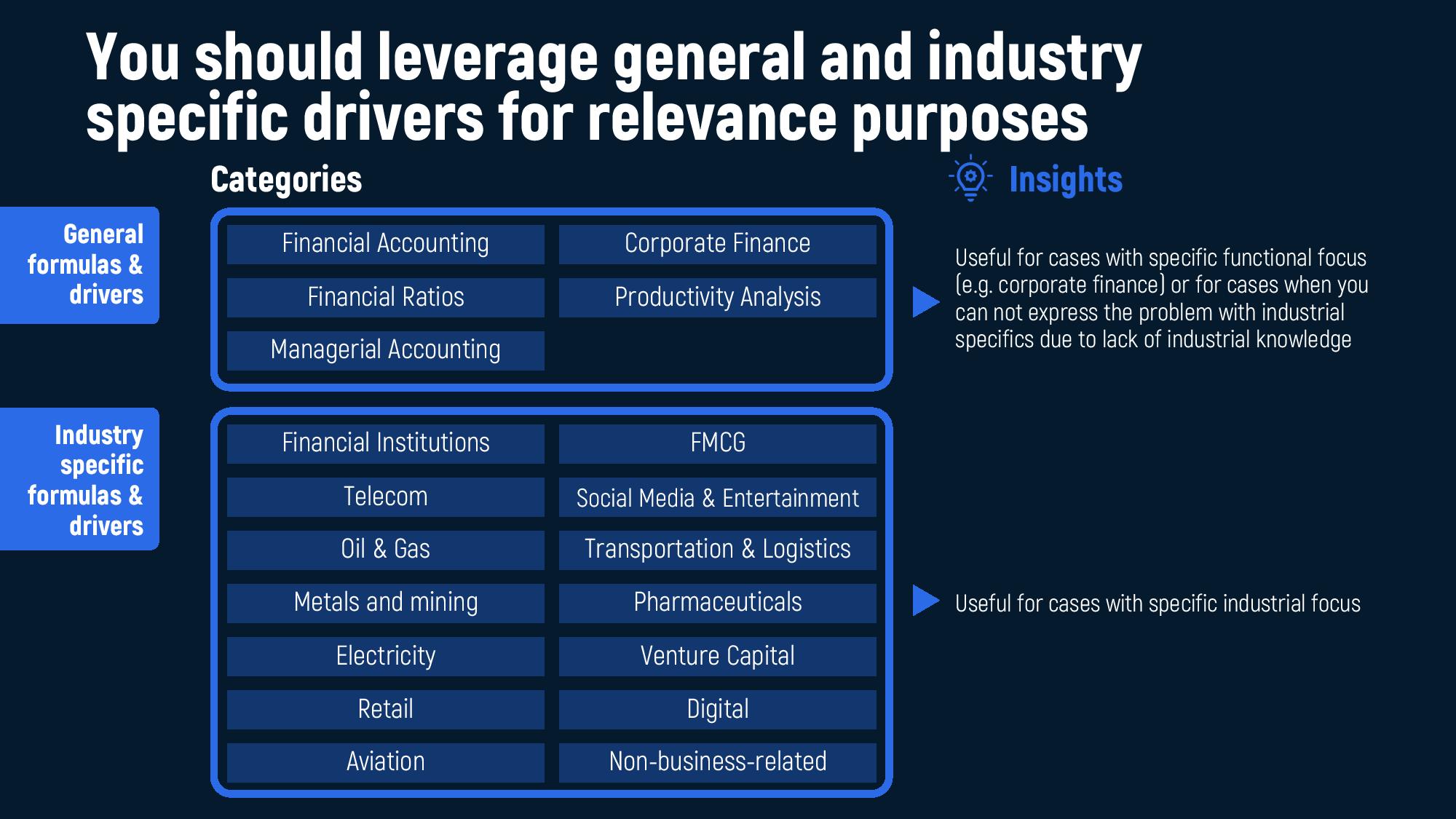
One of the biggest challenges in formula-based cases is knowing which drivers to use when you break down revenues and costs. A strong candidate doesn’t just rely on generic formulas — they adapt their framework to the specific industry context.
General drivers
Across all industries, there are universal formulas and ratios that can help structure profitability or financial performance:
- Revenue = Price × Volume
- Costs = Fixed + Variable
- Profit Margin = Profit ÷ Revenue
- Return on Investment (ROI) = Profit ÷ Investment
- Break-even Point = Fixed Costs ÷ (Price – Variable Cost per unit)
These general formulas are interview “must-haves.” They demonstrate that you can think in terms of financial fundamentals without overcomplicating the analysis.
Interview tip: Stick to drivers that are easy to calculate in your head. Avoid formulas that require detailed accounting data you wouldn’t have in an interview.
Industry-specific drivers
Different industries have their own P&L structures and performance metrics, and showing awareness of them can really set you apart in interviews.
- Airlines
-Revenue: load factor (seat utilization), route mix, ticket class pricing.
-Costs: fuel, maintenance, airport fees.
- Banking & Financial Institutions
-Revenue: net interest income, fee income, trading revenues.
-Costs: operations, compliance, IT infrastructure.
- Telecom
-Revenue: ARPU (average revenue per user), subscriber base, churn rate.
-Costs: network maintenance, customer acquisition costs.
- Retail
-Revenue: foot traffic × conversion rate × basket size.
-Costs: rent, supply chain, inventory write-offs.
- Energy & Utilities
-Revenue: production capacity × utilization rate × price per unit.
-Costs: extraction, distribution, regulation, environmental fees.
Interview tip: If you know which industry the case belongs to, adjust your structure immediately. For example, in retail, don’t just say “revenues depend on price and volume” — say “revenues depend on foot traffic, conversion rate, and basket size.” That level of tailoring shows consulting mindset.
Are You Ready for a Career a Top Company?
Answer three questions and get a personalized breakdown.
Solvability principle in case interviews
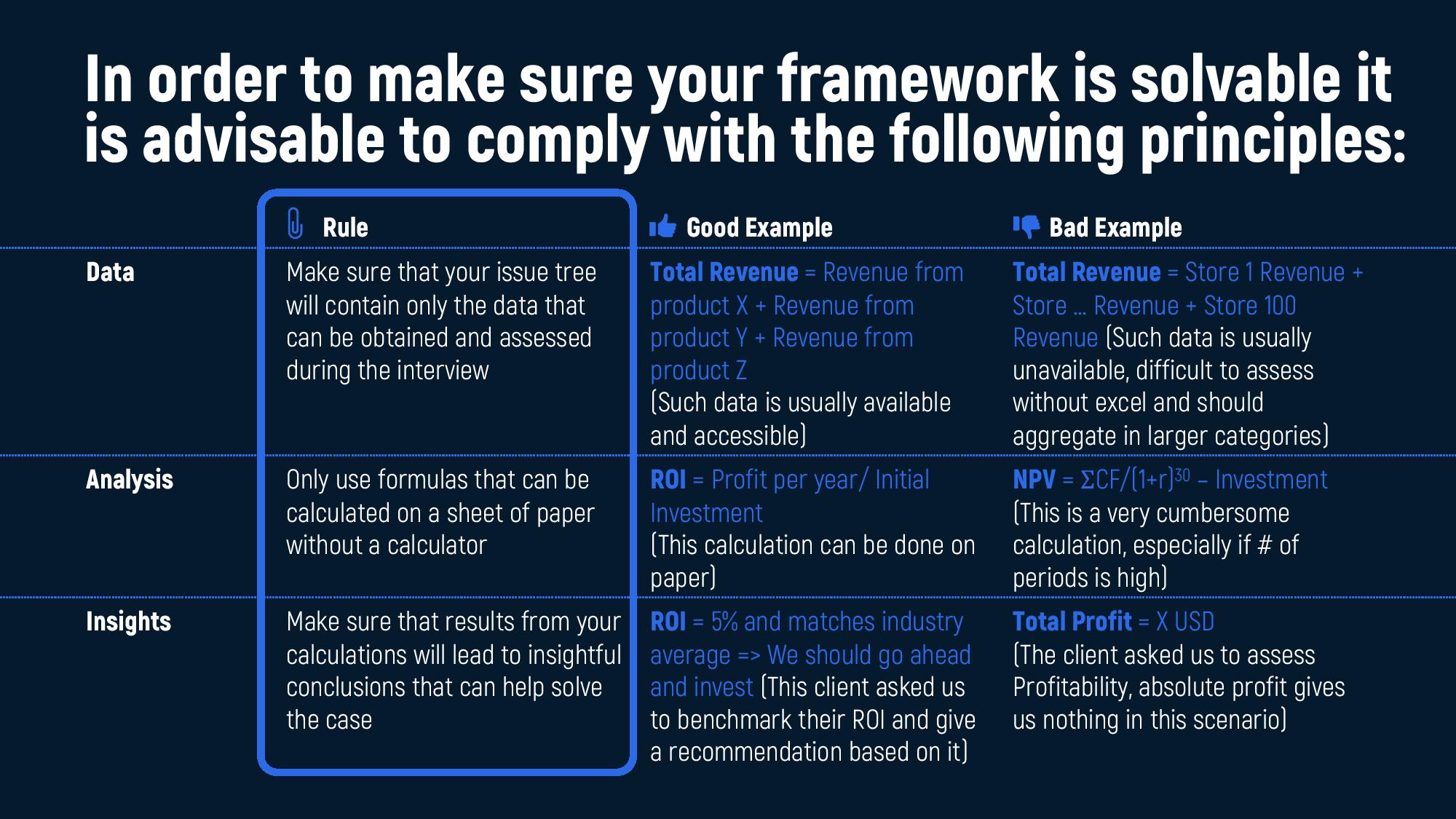
One of the most common mistakes in formula-based cases is building a framework that looks logical on paper but cannot actually be solved during the interview. To avoid this, you need to apply the Solvability Principle: always ensure that your structure uses data that can be reasonably estimated and leads to meaningful insights.
Data: use what can be assessed in the interview
When designing your framework, make sure you only include data points that are accessible and estimable without external tools.
- ✅ Good practice: Break down Total Revenue into product categories (Product X + Product Y + Product Z). Such information can be estimated logically.
- ❌ Bad practice: Breaking down revenue into hundreds of individual stores. This requires unavailable granular data and cannot be handled in an interview setting.
Analysis: keep calculations simple
Use formulas that can be quickly calculated on paper without a calculator.
- ✅ Good practice: ROI = Profit ÷ Investment. This is simple and realistic.
- ❌ Bad practice: NPV with 30 periods. This is far too complex and not interview-relevant.
The key is not to impress with complexity, but to show structured and practical problem-solving.
5.3 Insights: ensure calculations lead to conclusions
Every calculation should produce actionable insights, not just numbers.
- ✅ Good practice: ROI = 5%, benchmarked to the industry average → we recommend investing.
- ❌ Bad practice: “Profit = $10M.” Without context (is this high or low?), the number is meaningless.
Interview tip: Always link the result back to the business problem. Numbers alone don’t matter — what matters is how they guide a decision.
MECE principle for structuring frameworks
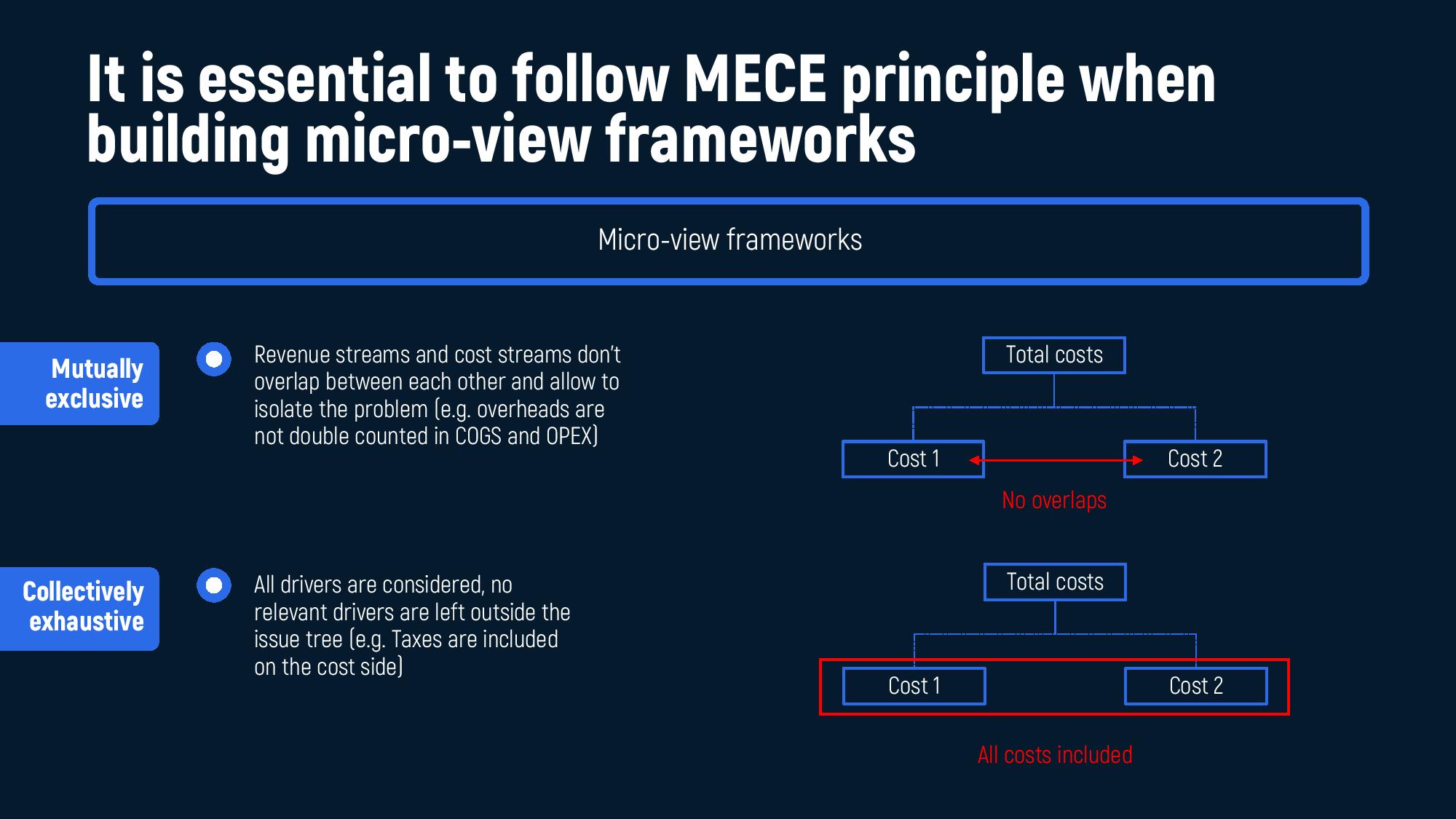
When solving case interviews, one of the golden rules of consulting is the MECE principle — Mutually Exclusive, Collectively Exhaustive. Applying it ensures that your framework is clear, avoids double counting, and fully covers the problem space.
Mutually exclusive
Each driver, segment, or category in your framework must be non-overlapping.
- ✅ Good practice: Splitting the fashion market into mass market vs. high fashion.
- ❌ Bad practice: Adding “affordable luxury” as a separate segment, since it overlaps with both mass and high fashion. This leads to double counting.
Interview tip: When segmenting, always ask yourself: “Is there any chance one item could fall into two categories?” If yes — restructure.
Collectively exhaustive
Your framework must cover all possible segments relevant to the problem.
- ✅ Good practice: When estimating the gaming console market, include both home consoles and handheld devices.
- ❌ Bad practice: Only including home consoles and ignoring handhelds, which leaves a big part of the market unaccounted for.
Interview tip: If you’re unsure whether you’ve included all factors, do a quick “sanity check” by thinking from another angle. For example: in education, besides B2C students, is there B2B demand from schools or institutions?
Why MECE matters in interviews
Interviewers are less interested in your final number and more interested in how you structure the problem. A MECE framework signals:
- Clear and logical thinking.
- Awareness of overlaps and gaps.
- Consulting-style problem solving.
Market segmentation patterns (B2C, B2B, B2G)
Segmentation is one of the most powerful tools in macro cases, especially in market sizing and go-to-market strategy questions. By splitting the market into meaningful groups, you avoid oversimplification and build a framework that reflects real-world dynamics.
B2C segmentation
In consumer markets, segmentation usually revolves around who the customers are and how they behave:
- Demographics – age, income, education, family size, gender, nationality.
- Behavioral – purchase frequency, customer journey stage, loyalty, risk tolerance.
- Psychographic – lifestyle, personality traits, values, interests.
- Geographic – city vs. rural, regional clusters, climate-driven differences.
Example: For gaming consoles in Japan, you might segment by age (teenagers, young adults, families) and then apply penetration and spending assumptions.
B2B segmentation
In business markets, segmentation is less about individuals and more about company characteristics and decision-making approaches:
- Demographics / Firmographics – industry, company size, number of employees.
- Geography – local vs. global footprint.
- Purchasing approach – centralized vs. decentralized, tender vs. relationship-based.
- Personal characteristics – decision-maker’s risk attitude, loyalty, or user status.
Example: When sizing the market for cloud services, you’d split companies by size (SMEs vs. enterprises) and geography, since adoption rates vary heavily.
B2G segmentation
Government clients follow very different logic compared to B2C or B2B. They often operate under budgets, regulations, and procurement processes:
- Agency type – education, defense, healthcare, local councils.
- Geography – federal, state, local, international.
- Government tier – quasi-governmental vs. direct agencies.
- Bid type – open competition vs. closed tenders.
Example: When estimating demand for cybersecurity solutions, you must distinguish between federal defense contracts (large, long-term) and local government tenders (smaller, short-term).

Sources of assumptions in market sizing
In macro cases, your framework is only as strong as the assumptions you use to fill it. Since interviewers don’t expect you to know exact market statistics, they want to see if you can justify your assumptions logically. Good candidates are not afraid to make estimates — but they always explain where those estimates come from.
Key sources of assumptions
1. Input from the interviewer or well-known facts
- Sometimes the interviewer will give you a number (e.g., “Assume the average price of a Boeing 737 is $50M”).
- Use these inputs confidently — they are designed to help you.
2. Statistical data (general knowledge)
- Population sizes, workforce share, urbanization rates.
- Example: “I know that about 50% of the population is usually part of the workforce.”
3. Personal experience (casual everyday insights)
- Drawing from common sense or consumer habits.
- Example: “Every fifth visitor in a café orders a cappuccino.”
4. Workplace or project experience
- Industry-specific knowledge from previous internships, jobs, or coursework.
- Example: “In FMCG, I know toothbrushes are typically replaced once a month.”

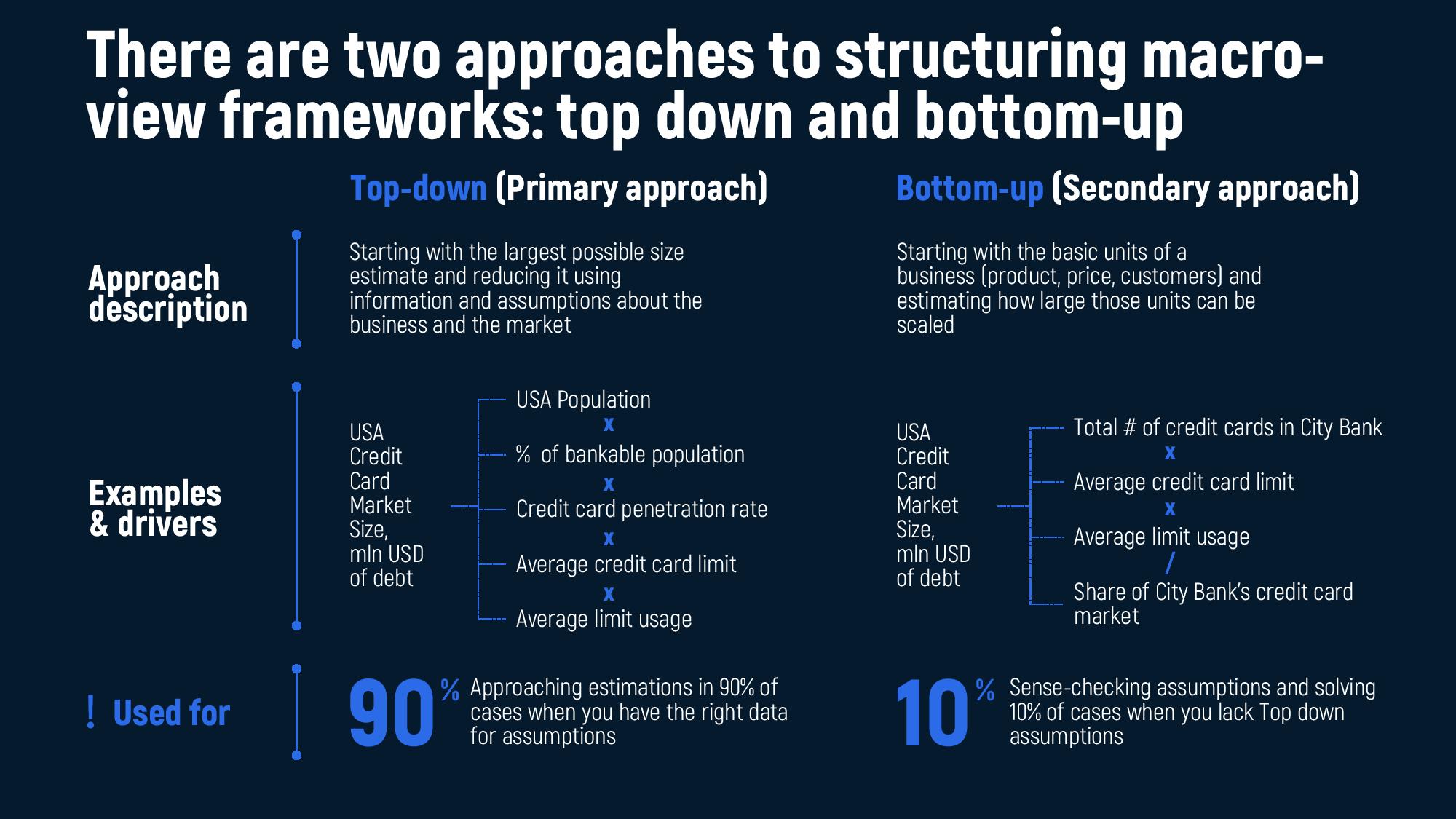
Top-down (primary approach)
In a top-down approach, you start with the largest possible population and progressively narrow it down using assumptions.
Example: Estimating the U.S. credit card market size
- Start with total U.S. population.
- Apply % of bankable population (those eligible to hold credit cards).
- Apply credit card penetration rate.
- Multiply by average credit limit.
- Adjust for average usage rate (how much of the limit is actually used).
This method is the most common in interviews because it works in about 90% of cases when broad, reliable assumptions (population, penetration, averages) are available.
Interview tip: When using top-down, show clear logic in narrowing down the funnel. Even if your numbers are rough, the structure earns points.
Bottom-up (secondary approach)
In a bottom-up approach, you start with micro-level units (like companies, stores, or customers) and scale them up to estimate the total market.
Example: U.S. credit card market (bottom-up check)
- Start with the number of credit cards in a specific bank (e.g., Citibank).
- Multiply by average credit card limit.
- Multiply by average utilization rate.
- Divide by Citibank’s market share to scale to the total market.
This approach is less common but useful for cross-checking your top-down result or when detailed company data is available.
Interview tip: If you have time, offering a quick bottom-up check shows depth and adds credibility to your estimate.
When to use each approach
- Top-down: Best when you have broad demographic or macro data (population, penetration, averages).
- Bottom-up: Best when you know company-specific figures or want to sanity-check your top-down result.
- Combined: The strongest answers triangulate both approaches.
MECE principle for structuring frameworks
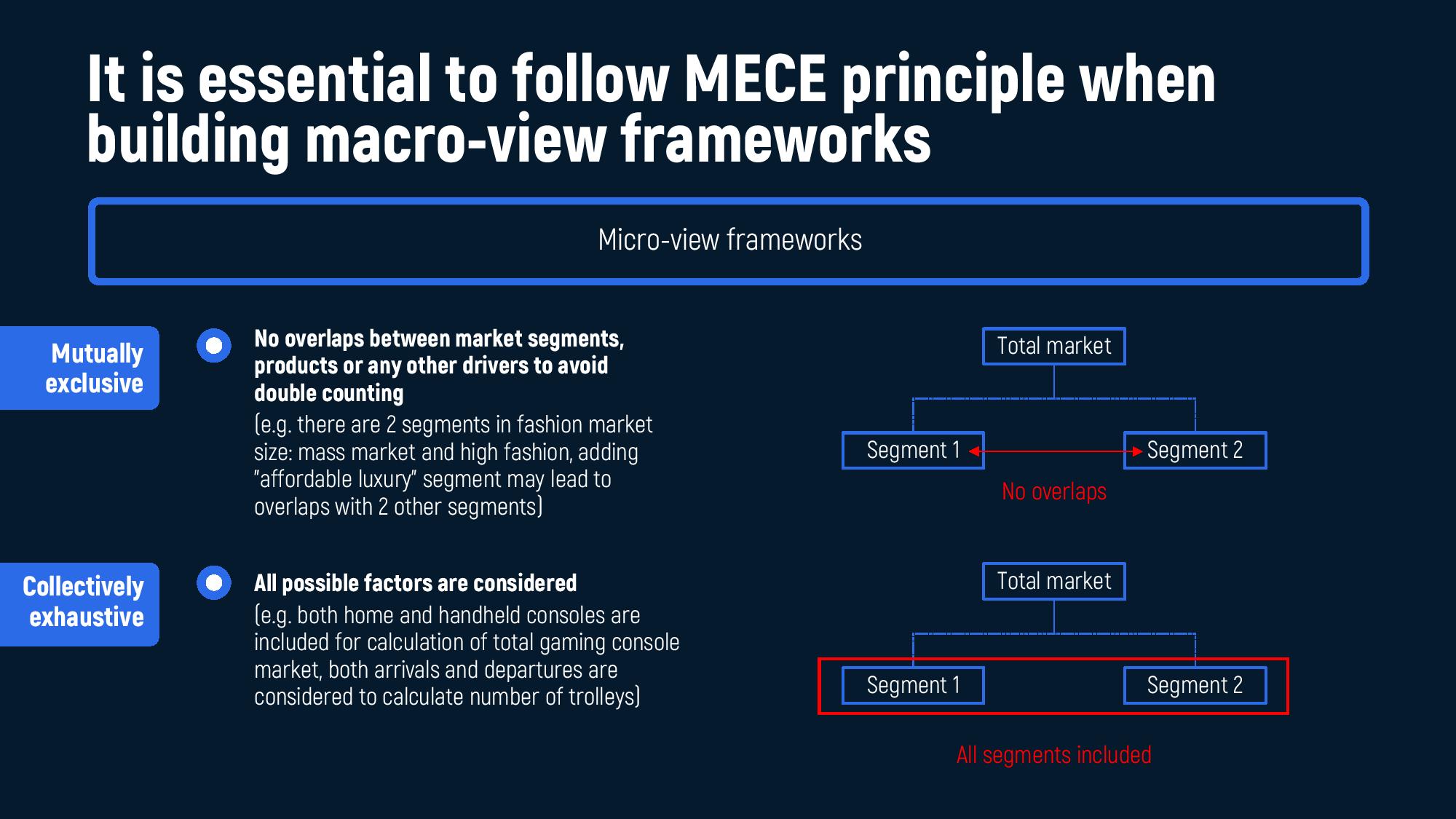
A critical element of strong case interview performance is structuring your framework in a way that is both comprehensive and non-overlapping. This is where the MECE principle comes in — Mutually Exclusive, Collectively Exhaustive.
Mutually exclusive
Your categories or segments must be clearly separated, with no overlap. Otherwise, you risk double counting and inflating results.
- ✅ Example: Splitting the fashion market into mass market and luxury.
- ❌ Bad practice: Adding an “affordable luxury” category that overlaps with both.
This ensures clarity and precision in your structure.
Collectively exhaustive
Your framework should cover all relevant factors so that nothing important is left out. Missing segments leads to underestimating the market or overlooking key cost drivers.
- ✅ Example: When sizing the gaming console market, include both home consoles and handheld devices.
- ❌ Bad practice: Only including home consoles while ignoring handhelds, which represent a significant part of the market.
This guarantees that your analysis reflects the full picture.
Conclusion and interview tips
Formula-based cases — whether micro P&L breakdowns or macro market sizing — are not about guessing the perfect number. They are about showing structured, logical, and business-oriented thinking under time pressure.
If you master the principles covered in this guide — solvability, MECE, segmentation, top-down vs. bottom-up approaches — you will be equipped to tackle almost any case interview.
Key takeaways
- Micro cases: Break down revenues and costs clearly, adapt to industry specifics, and look for the driver behind profitability changes.
- Macro cases: Choose between demand-driven or supply-driven formulas, and use segmentation to refine your logic.
- Solvability: Always keep calculations simple, data accessible, and insights meaningful.
- MECE: Ensure no overlaps and no missing segments in your framework.
- Assumptions: Be transparent about where they come from — interviewer input, statistics, work experience, or common sense.
- Approaches: Default to top-down, but add bottom-up checks when possible.
Practical interview tips
- Verbalize your logic – Interviewers want to follow your thought process, not just hear the final number.
- Sanity-check results – Ask yourself: Does this outcome make sense compared to real-world benchmarks?
- Turn numbers into insights – Don’t stop at “the market is $10B”; explain what it means for the client.
- Practice with variety – Train across different industries and case types to avoid being caught off guard.
- Stay calm under pressure – Structured logic always matters more than exact precision.
