

Introduction
Consulting market segments
The consulting market in 2025 is represented by wide sections each of which has its own features and is attractive in its own way.
MBB (McKinsey, BCG, Bain):
The most prestigious segment is the MBB (McKinsey, BCG, Bain), a collective brand, which stands for the three top-tier consulting firms. These organizations are standard-bearers in the analytics community and are globally respected for their thorough selection process, impact projects, and robust alumni networks.
Big Four Consulting Firms (Deloitte, PwC, EY, KPMG):
The Big Four consulting firms are popular with their huge size, broad range of services, and huge industry know-how.
Boutique Consulting Firms:
Boutique consulting firms are more often than not the ones who introduce and play the most progressive role, whereas tier 2 consulting firms focus more on specialized areas and provide a more entrepreneurial culture.
Tier 2 Consulting Firms:
This group includes firms like Oliver Wyman, Roland Berger, and Strategy&, which embody certain aspects from both MBB and Big Four. These companies target comfortable training, overseas operations, and projects that intertwine strategy and execution.
Inhouse Consulting:
A number of the big enterprises in the market have formed internal consulting teams to incorporate and realize strategy development and change. These roles provide substantial opportunities to candidates as they can work on the hottest projects in a single organization typically with a more improved work-life balance than the external consulting.
The global consulting firms have across the world many projects and international opportunities for candidates with such background.
Key players and their characteristics
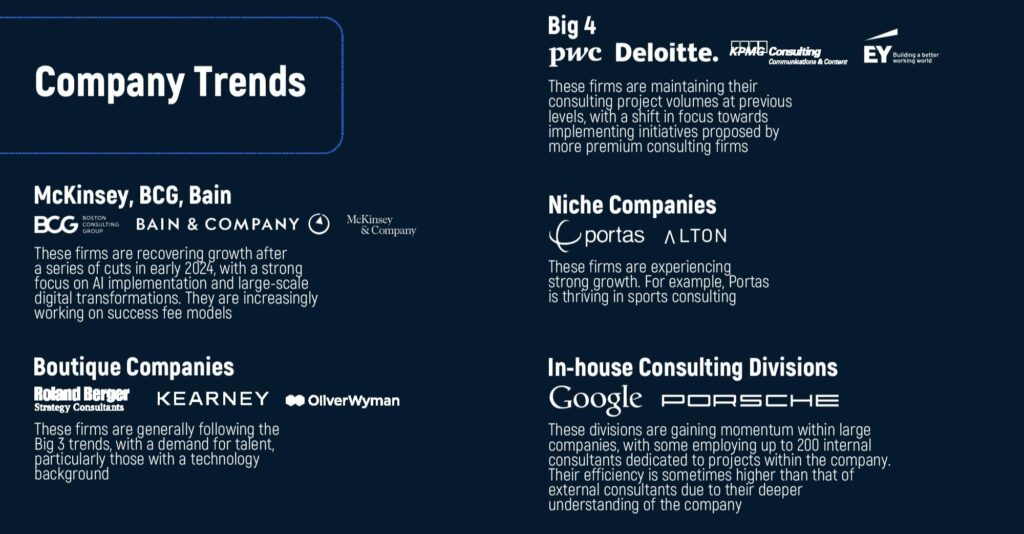
Comparison of consulting firms shows clearly the top consulting firms are different from each other.
MBB Firms:
MBB firms follow the high-level strategy paradigm, their interview processes are of a very hard caliber, and overall the culture is of a beyond edge learning. For instance, McKinsey interviewers will check a candidate’s ability to structure a problem, make clarification questions, and the usage of consulting frameworks in generating actionable insights. Candidates have to structure the cases appropriately and answer the questions correctly, as the interviewers seek the demonstration of strong analytical and communication skills.
Big Four:
The Big Four, as the name suggests, presenting themselves as big and strong through their size and versatility. Their projects usually go wider across a range of industries where they require candidates to be creative and to exhibit leadership qualities such as managing many stakeholders in a complex operating environment. In some of the interviews, the focus of the discussions could be operational cases, financial analysis, and the need for achieving measurable results amidst slim time frames.
Boutique and Tier 2 Consulting Firms:
The boutique and tier 2 consulting firms attract the candidates more so with their unique or entrepreneurial culture. Those companies favor the people who are flexible enough to switch to entirely new branches, gain specialized knowledge and create a firm relationship with the customers. The interviewers could lay out instances that demand advanced creative approaches and being comfortable with going out of the box.
Are You Ready for a Career a Top Company?
Answer three questions and get a personalized breakdown.
Trends shaping the landscape
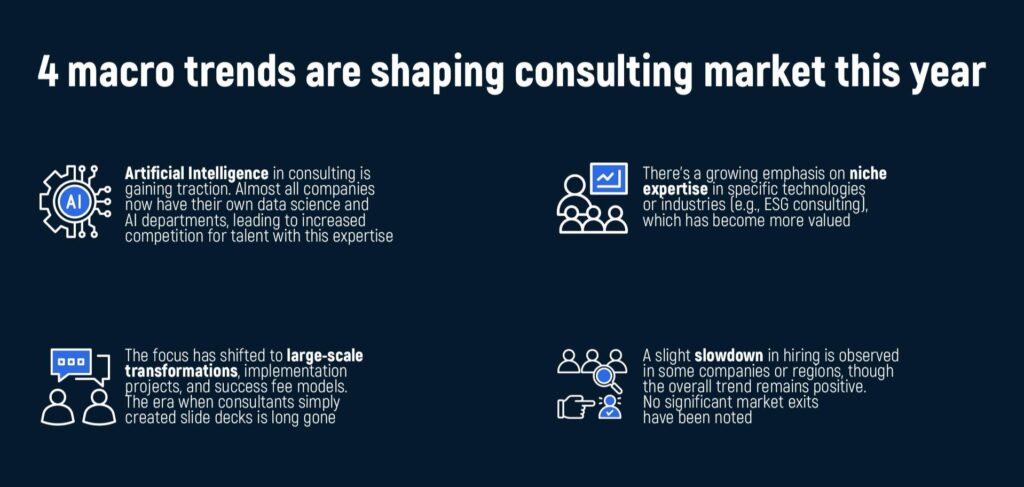
The consulting industry shouldered shifts through technology, client expectations, diversity, equity, and inclusion (DEI), and sustainability. Notable elements to note on an operational shift are:
Digitalization and AI:
There is a mounting reliance on artificial intelligence and digital resources in the quest for value addition by firms. Thus, the candidates should have knowledge of data analysis, digital transformation cases, and technology integration into business solutions. Recruiters evaluate the candidates’ ability to assess data, comprehend visual representation, and apply digital tools during their case interviews.
Client Expectations:
Clients require more than classic conceptual advice—they want consultants to deliver tangible results and assist in the implementation. The change insists on the candidates not only outlining issues but also the need of managing change and project execution.
Diversity, equity, and inclusion (DEI):
Among the top consulting firms DEI is a main focus in hiring people and project teams. The candidates should stand ready to share their experience in diverse works and their commitment to the inclusive problem solving.
Sustainability:
In the long term, environmental and social considerations come to the forefront of several consulting projects. Consequently, a part of the interview that is related to these topics can be oriented by sustainability, ESG (Environmental, Social, Governance) factors, and ask about ways to integrate these points in business cases.
Evolving interview formats:
The design of consulting interviews is progressively changing stating the focus on whether to conduct virtual interviews, real-time data analysis, or interactive case formats. Apart from the conventional case interviews, candidates have to practice their digital literacy and remote collaboration capabilities through adaption to new formats.
Regional Insights: How Consulting Evolves Around the World
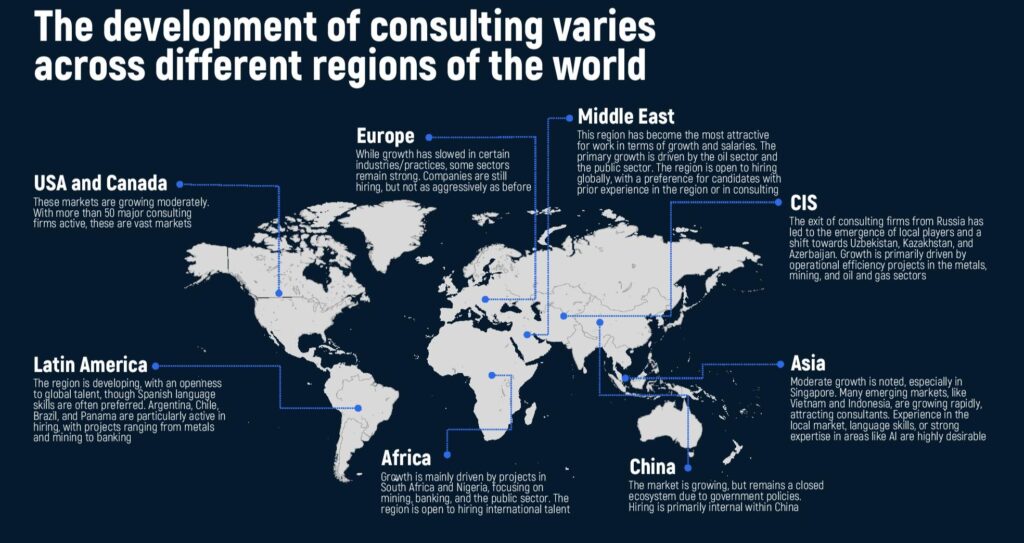
The consulting industry doesn’t grow uniformly—each region has its own pace, focus sectors, and hiring practices. Understanding these differences can give candidates a strong edge.
USA & Canada
Mature markets with steady growth. Over 50 major firms operate here, offering a wide range of project types.
Europe
Hiring has slowed in some industries but remains active. Flexibility and industry expertise are key.
Explore what it’s like to work in consulting in Paris — watch the YouTube video to learn about the lifestyle, project types, and market specifics
Middle East
The fastest-growing region, driven by oil and public sector projects. Experience in the region or sector is a plus.
Curious about consulting opportunities in Dubai? Watch the video here to dive into hiring trends, expat life, and local business culture.
Asia
Growth in Singapore and emerging markets like Vietnam and Indonesia. Local knowledge and tech skills (e.g. AI) are valued.
China
Growth is internal due to strict government policies. Limited access for international candidates.
Latin America
Open to global talent, especially Spanish speakers. Active markets include Argentina, Brazil, and Chile.
Africa
Growth in South Africa and Nigeria, focused on mining, banking, and public sector. International talent welcomed.
CIS
After many firms exited Russia, growth shifted to Central Asia (e.g., Kazakhstan, Uzbekistan). Projects often focus on energy and efficiency.
Why it matters
What recruiters specifically look for
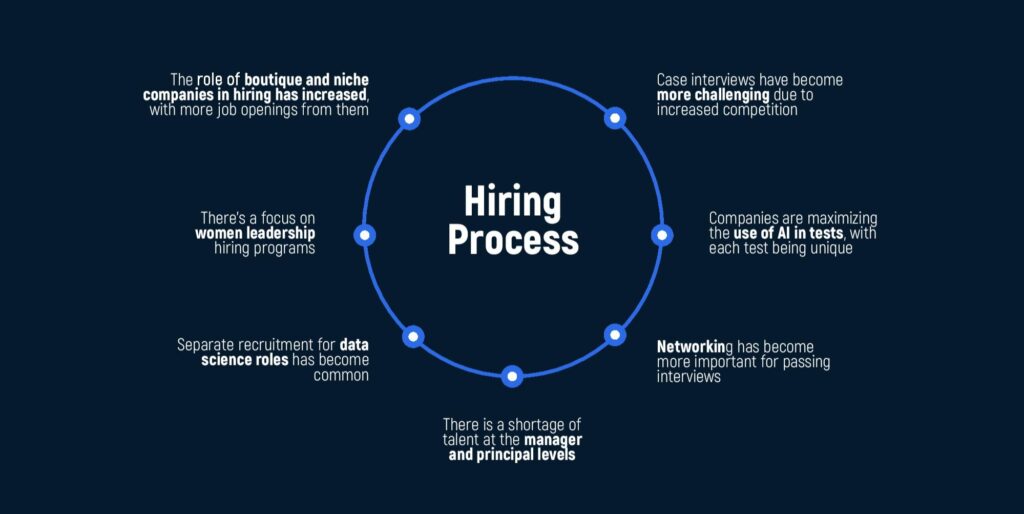
In top consulting firms recruiters want to see candidates that can:
- Compile unclear problems in an orderly and complete way.
- Clearly and confidently express their thought processes.
- Utilize consulting frameworks and principles e.g. MECE, solvability.
- Demonstrate flexibility in acquiring new skills and encountering new challenges.
- Give answers that are verifiable by data and that are actionable to complex issues.
How Case Interviews Look Like Today
Consulting interviews have evolved beyond traditional formats. Firms now incorporate live problem-solving, and real-time data analysis into their case processes.
Check out this YouTube video example of a case interview to see what top firms look for in terms of structure, logic, and communication.
